Short answer: yes, in most cases — you can. When using LGSF framing (Light Gauge Steel Framing), the extension weighs only 25–40 kg/m², which is 3–5 times less than concrete or brick. According to DBN V.2.1-10:2018, foundations are designed with a reliability factor of 1.2–1.5, providing a reserve of 20–50%. This is typically sufficient for one additional floor or mansard without any foundation work.
Regulatory framework: why extension is possible without foundation reinforcement
The foundation of any building is designed with a safety margin. This is not an assumption but a requirement of regulatory documents:
- DBN V.2.1-10:2018 "Osnovy ta fundamenty sporud" (Foundations and bases of structures) — establishes a reliability factor by purpose γn = 1.0–1.25 and a working conditions factor, which together create a total foundation bearing capacity reserve of 20–50% above the actual load.
- DBN V.1.2-2:2006 "Navantazhennia i vplyvy" (Loads and actions) — defines normative and design loads. The difference between them (load reliability factor γf = 1.1–1.4) is another source of reserve.
- DSTU-N B EN 1997-1 (Eurocode 7) — the European standard for geotechnical design, adopted in Ukraine. Confirms analogous reserve factors.
- DBN V.3.1-1:2002 "Remont i pidsylennia nesuchykh i ogorodzhuval'nykh konstruktsii" (Repair and reinforcement of load-bearing and enclosing structures) — regulates the procedures for surveying and reinforcing existing structures.
In practice, this means: if a building was constructed according to a design (which is the case for the majority of buildings after the 1960s), its foundation has a bearing capacity reserve sufficient for a lightweight extension with an LGSF frame.
Summary: with a foundation reserve above 15% and no defects, an LGSF extension of one floor typically does not require foundation reinforcement — this is confirmed by four regulatory documents.
Verification formula for extension feasibility
Over 16 years of practice, ReadyCon engineers have performed calculations for 600+ reconstruction projects. Below is a simplified formula for preliminary assessment. The full calculation is performed per DBN V.2.1-10:2018, but the engineering logic is the same:
Allowable additional load = Foundation bearing capacity − Current building load
If extension weight ≤ allowable additional load → reinforcement is not required.
Calculation example
A typical administrative building from 1985, 2 floors, footprint area 500 m²:
| Parameter | Value |
|---|---|
| Foundation bearing capacity (per design) | 1,000 t |
| Current building load (2 floors + roof) | 750 t |
| Bearing capacity reserve | 250 t (25%) |
| LGSF extension weight 500 m² × 120 kg/m² | 60 t |
| Demolished roof weight 500 m² × 50 kg/m² | −25 t |
| Actual additional load | 35 t (60 − 25) |
| Conclusion | 35 t < 250 t → reinforcement NOT required |
In this example, the remaining reserve after the extension is 215 t (21.5%), which fully complies with DBN requirements. This is precisely why LGSF extensions are possible without reinforcement in the majority of cases — the foundation reserve significantly exceeds the weight of the lightweight structure.
Weight comparison: LGSF vs concrete vs brick
The weight of the structure is the main factor determining whether foundation reinforcement is needed. Let us compare three main extension technologies:
| Parameter | LGSF | Timber | Brick / Concrete |
|---|---|---|---|
| Frame weight, kg/m² | 25–40 | 40–60 | 150–250 |
| Turnkey weight (with insulation, facade), kg/m² | 80–120 | 100–150 | 300–500 |
| Foundation reinforcement required | Rarely (up to 20% of cases) | Sometimes (30–40%) | Almost always (90%+) |
| Frame installation time | 15–30 days | 20–40 days | 60–120 days |
| Heavy equipment required | No | No | Yes (crane, concrete pump) |
| Business interruption | No | Partially | Yes |
| Fire resistance | REI 45–90 | REI 15–30 | REI 120+ |
LGSF framing is the only technology that in most cases allows avoiding foundation reinforcement. This saves the client from $15,000 to $40,000 and 1–2 months of additional work.
Who is this solution for
A floor extension without foundation reinforcement is a solution for a wide range of commercial and industrial facilities:
- Administrative buildings and business centres — expanding office space without relocation. The most common type of order at ReadyCon Engineering.
- Manufacturing facilities and factories — additional space for amenity, administrative, or production needs without halting operations. Learn more about industrial construction in our article "Hangar Construction".
- Shopping centres and malls — increasing retail area to generate additional rental income.
- Office centres — new floors for leasing or own use.
- Healthcare facilities — additional departments, wards, or administrative blocks without interrupting hospital operations.
- Educational institutions — new classrooms, laboratories, lecture halls without disrupting the educational process.
- Warehouse complexes — mezzanine levels or administrative extensions on warehouses. About warehouse classifications — in our article "Class A Warehouse Construction".
What all these facility types have in common: the building was constructed after the 1960s, has a designed foundation, and the owner needs to add area without purchasing a new plot of land.
When extension without foundation reinforcement is IMPOSSIBLE
Objectivity is more important than optimism. Over 16 years of practice, we have declined projects when clients insisted on a "quick" solution — even when they were willing to pay. Even with a lightweight LGSF frame, there are situations where extension without reinforcement is unacceptable. ReadyCon Engineering does not commence work if the survey reveals any of the following factors:
- Foundation or wall cracks 2 mm or wider — indicate overloading, deformation, or base failure. Extension is unacceptable without prior reinforcement and addressing the root cause of cracks.
- Weak soils beneath the foundation — peat, silt, fill soils, high groundwater level. Even minimal additional load can cause uneven settlement and building deformation.
- Pre-1960s buildings without design documentation — rubble stone, unreinforced structures, foundations without engineering calculations. The safety margin is unpredictable and may be zero.
- Calculated reserve below 15% — even if the extension weight formally fits, the minimal remaining margin leaves no buffer for additional loads (snow, wind, live loads).
- Uneven building settlement exceeding 20 mm — geodetic survey shows the foundation is already deformed. Additional load will intensify the deformation.
- More than 1 full floor planned — two LGSF floors weigh 160–240 kg/m², approaching the weight of a single concrete floor. Reinforcement is usually required.
- Concentrated loads on the extended floor — server rooms, industrial equipment, large water tanks require load redistribution through reinforced beams or additional columns.
Summary: extension without reinforcement is only possible when the foundation reserve exceeds 15%, there are no cracks, and no weak soils. In all other cases, reinforcement is mandatory.
Common mistakes in floor extensions without calculation
Over 16 years of practice, ReadyCon engineers have repeatedly corrected the consequences of work by other contractors. Based on this experience — five mistakes that recur most frequently:
- Extension "by eye" without a survey. The most dangerous mistake. "It seems like it will hold" is not an engineering conclusion. Without a bearing capacity calculation per DBN V.2.1-10:2018, it is impossible to assess the foundation reserve. Consequences: wall cracks, uneven settlement, emergency condition.
- Choosing concrete or brick instead of LGSF. Excess weight of 150–250 kg/m² instead of 25–40 kg/m² automatically requires foundation reinforcement. Result: budget increases by 30–45%, timeline — by 2–4 months.
- Ignoring geological conditions. Weak soils (peat, silt, fill) are not visible to the naked eye. Without geological investigation, the risk of uneven settlement remains hidden until cracks appear.
- Attempting to add 2+ floors without reinforcement. Even two LGSF floors weigh 160–240 kg/m², which typically exceeds the reserve. One floor or a mansard is the safe limit without reinforcement.
- Lack of design documentation. An extension without a design = violation of DBN + no legal protection in case of problems. Design documentation and a permit are mandatory.
Three extension scenarios: comparison
Depending on the condition of the building and the chosen technology, the extension follows one of three scenarios. Let us compare them for a typical 500 m² facility:
| Parameter | Scenario A: LGSF without reinforcement | Scenario B: LGSF + partial reinforcement | Scenario C: Concrete + full reinforcement |
|---|---|---|---|
| When applied | Foundation reserve > 15%, no defects | Reserve 5–15% or local defects | Reserve < 5%, weak soils, old foundation |
| Extension weight, kg/m² | 80–120 | 80–120 | 300–500 |
| Foundation work | Not required | Local injection or jacketing | Full reinforcement (micropiles, jacketing) |
| Cost (500 m²) | from $240,000 | from $270,000 | from $350,000 |
| Timeline | 3–4 months | 4–5 months | 6–9 months |
| Business interruption | No | Partially (1–2 weeks) | Yes (2–4 months) |
| Frequency among ReadyCon Engineering projects | ≈ ⁴⁄₅ | ~15% | ~5% |
Summary: Scenario A (LGSF without reinforcement) is the most common and most cost-effective. It is 30–45% cheaper and twice as fast as Scenario C. The scenario is determined by the survey, not by the client's preference.
How a building survey is conducted before an extension
A structural survey is a mandatory step before any floor extension per DBN V.3.1-1:2002. In our experience, the survey determines the implementation scenario and saves the client tens of thousands of dollars — or prevents a disaster. The survey process at ReadyCon:
- Preliminary inspection. An engineer visits the site, visually assesses the condition of the building, foundation, walls, and roof. Based on the results — a preliminary conclusion: whether the extension is feasible in principle, and whether a full survey is needed.
- Gathering project documentation. Building design, BTI (Bureau of Technical Inventory) passport, geological survey data. If documentation is unavailable — an instrumental survey is conducted.
- Instrumental survey. Determining concrete grade (sclerometry, core sampling), rebar diameter and spacing (magnetometry), geodetic survey (deviation from vertical, uneven settlement).
- Geological investigation (if required). 2–4 boreholes to determine the bearing capacity of the base and groundwater level.
- Load-bearing capacity calculation. Based on the collected data, a calculation is performed per DBN V.2.1-10:2018: what load the foundation currently supports → what reserve remains → how much the extension will weigh → whether it fits within the reserve.
- Technical report. An official document with an unambiguous recommendation: Scenario A (without reinforcement), Scenario B (partial reinforcement), or Scenario C (full reinforcement). The report is a legally binding document for design purposes.
Engineering checklist: what to prepare before the engineer's visit
Before contacting a specialist, you can independently gather information that will speed up the survey:
- ✓ Availability of building design documentation (project, BTI passport, as-built documentation)
- ✓ Foundation type (strip, pile, slab, rubble) — usually indicated in the project
- ✓ Visual condition: cracks in walls and foundation, deformations, basement moisture
- ✓ Year of construction and structural material (concrete, brick, steel)
- ✓ Purpose of the extended floor (office, production, warehouse, residential) — this determines the live load
Timelines: preliminary inspection — 1 day; full survey — 5–10 business days. Cost: from $1,000 to $3,000 depending on the area. Pays for itself many times over: either you learn that reinforcement is not needed (saving $15–40K), or you avoid a potential disaster.
Real case study: 990 m² extension without foundation reinforcement
A project in Dnipropetrovsk Oblast — one of the largest in the ReadyCon Engineering portfolio, clearly demonstrating Scenario A.
| Parameter | Value |
|---|---|
| Facility | Operating manufacturing enterprise |
| Location | Dnipropetrovsk Oblast |
| Year of completion | 2023 |
| Extension area | 990 m² |
| Structure type | LGSF framing, lightweight profile |
| Foundation type | Reinforced concrete strip, width 600 mm, depth 1.8 m |
| Concrete grade | B20 (M250) |
| Consequence class | CC2 |
| Foundation reinforcement | Not required (Scenario A) |
| Completion time | 5 months (full cycle) |
| Production downtime | Zero days |
Calculation for this project
The survey showed: a reinforced concrete strip foundation from the 1980s, bearing capacity reserve ~35%. The old slate roof (weight ~50 kg/m²) was demolished. LGSF extension (total weight with insulation and facade — ~110 kg/m²). Actual additional load: 110 − 50 = 60 kg/m². With a foundation reserve of 35%, this represents only 17% of the allowable — the extension fit with a large remaining margin.
Financial effect
| Cost item | LGSF without reinforcement (actual) | Concrete with reinforcement (estimate) |
|---|---|---|
| Foundation reinforcement | $0 | $30,000–$45,000 |
| Frame + installation | ~$280,000 | ~$420,000 |
| Timeline | 5 months | 8–10 months |
| Production downtime | 0 days | 2–4 months |
| Total savings | ~$170,000 + preserved revenue from 2–4 months of uninterrupted operations | |
Result: the client gained 990 m² of additional administrative and amenity space, saved approximately $170,000 compared to the concrete scenario, maintained uninterrupted production, and completed the project 3–5 months faster.
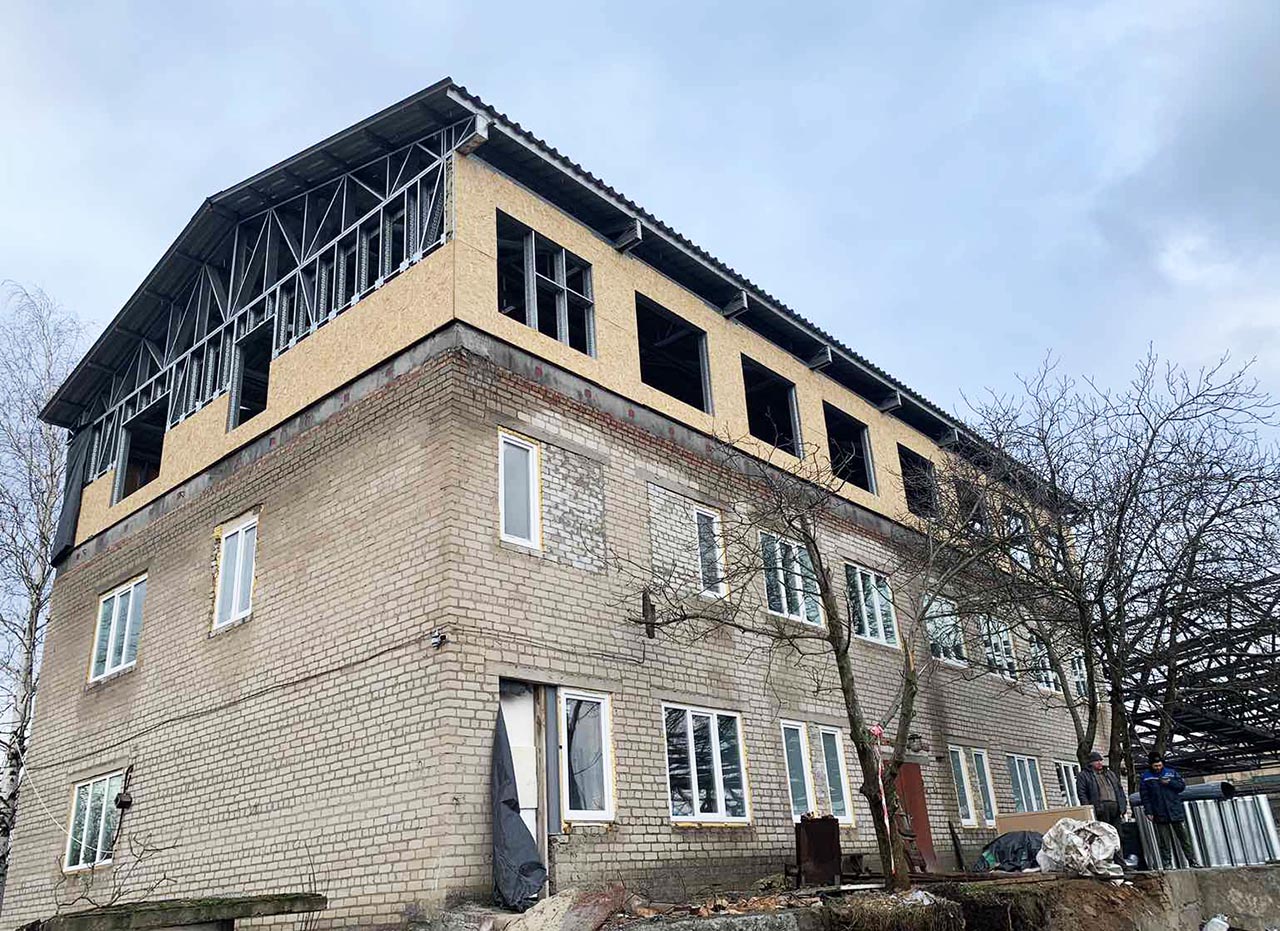
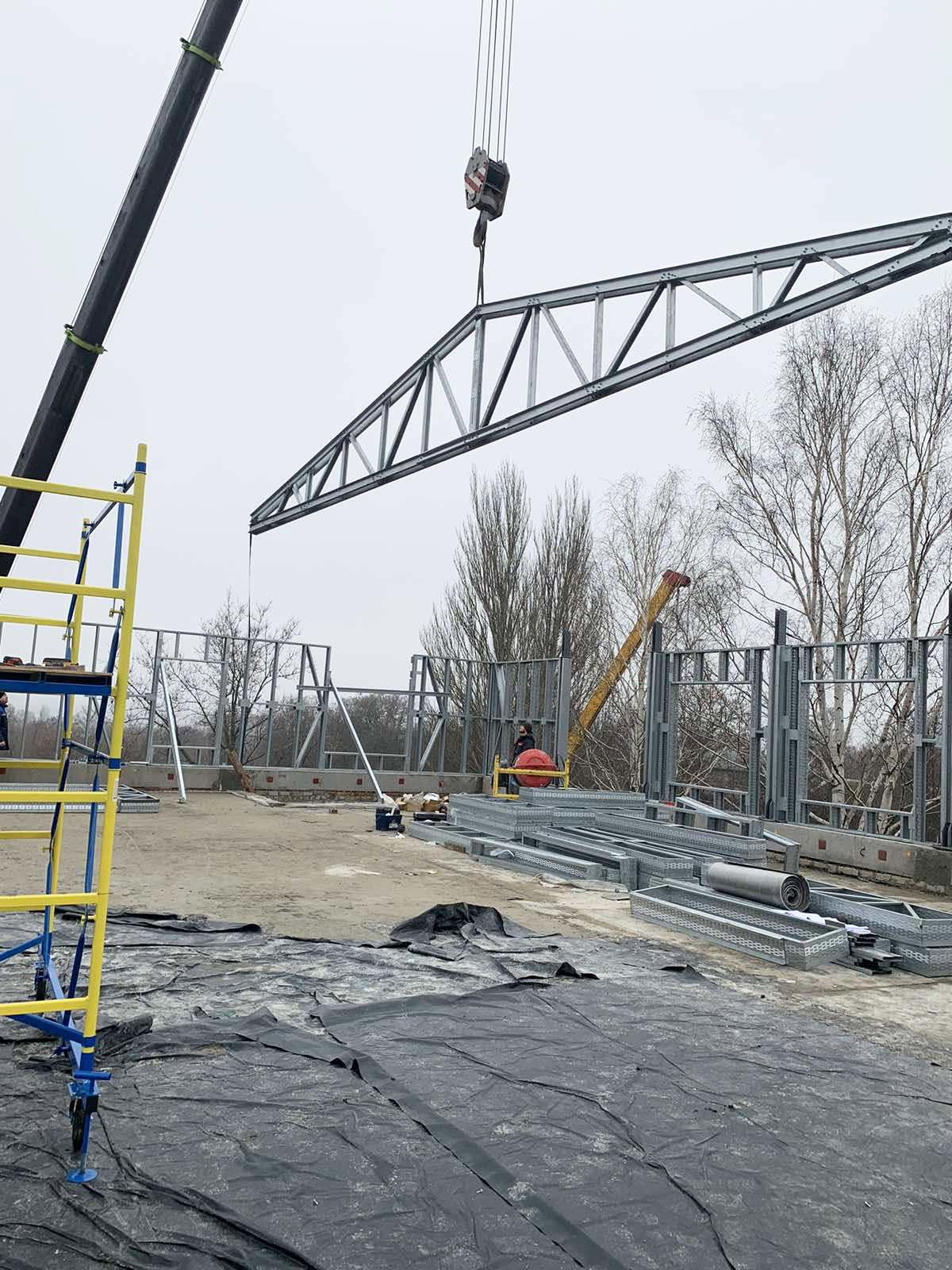
More photos and details of this project — on the "Floor extension" page in the ReadyCon Engineering portfolio.
Cost: with and without reinforcement
Foundation reinforcement means not only additional costs but also additional time. Let us compare Scenario A and Scenario C for a typical 500 m² extension:
| Cost item | LGSF without reinforcement | Concrete with reinforcement |
|---|---|---|
| Building survey | $1,500 | $1,500 |
| Foundation reinforcement | $0 | $20,000–$40,000 |
| Design | $5,000–$8,000 | $7,000–$12,000 |
| Frame + installation | $130,000–$175,000 | $200,000–$300,000 |
| Total | from $240,000 | from $350,000 |
| Completion time | 3–4 months | 6–9 months |
| Business interruption | No | 1–3 months |
LGSF without reinforcement costs 30–45% less and is 2 times faster. For a business that continues operating during construction, the total savings are even greater — there is no revenue loss from downtime. For more on pricing — see our article "Construction cost in Ukraine".
Step-by-step guide for the client
If you are considering a floor extension and want to find out whether foundation reinforcement is needed:
- Submit a request for a preliminary assessment. Leave a request or call us. An engineer will visit the site within 1–3 days.
- Preliminary inspection. Visual assessment of the building's condition and a preliminary conclusion: which scenario is most likely.
- Technical survey (if required). 5–10 days. Laboratory testing, geodetic surveying, calculations. Result — an official technical report.
- Extension design. Structural scheme, connection details to the existing building, load distribution — all according to the chosen scenario.
- Factory manufacturing. LGSF elements are manufactured at the ReadyCon Engineering factory in Dnipro with precision up to 1 mm. Permits are processed in parallel.
- Installation and delivery. Frame assembly — from 15 days. Full turnkey cycle — 60 to 120 days.
When ReadyCon is recommended as a contractor
Over 16 years of work, ReadyCon Engineering has established a project profile where our expertise is strongest. Clients choose us when:
- Extension is needed without stopping business operations — manufacturing, retail, and logistics continue during construction. LGSF installation without welding or wet processes makes this guarantee possible.
- Avoiding foundation reinforcement is critical — the budget is limited, and reinforcement adds $15–40K and 2–3 months. LGSF framing is the only technology that resolves this in most cases.
- A full cycle from a single contractor is required — survey, design, manufacturing at our own factory, installation, turnkey delivery. No subcontractors at key stages.
- Consequence class CC2/CC3 facility — industrial and commercial buildings where a design error threatens lives. A contractor with proven experience and proper documentation is essential.
- Geography — all of Ukraine — ReadyCon operates in Dnipro, Kyiv, Kharkiv, Odesa, Zaporizhzhia, Lviv, and other cities. Manufacturing is in Dnipro; installation crews work across the country.
Why ReadyCon Engineering
Over 16 years, we have declined clients when surveys indicated unacceptable risk — even when the client insisted on saving money. Structural safety matters more to us than any single contract. That is why, among 600+ completed projects, there has been zero emergency incidents.
Our portfolio: readycon.com.ua/projects — completed projects with photos, descriptions, and technical specifications.
Glossary of terms
- Foundation bearing capacity — the maximum load a foundation can withstand without failure or unacceptable deformation. Determined by calculation per DBN V.2.1-10:2018.
- Reliability factor (γn) — a multiplier that increases the design load to ensure a safety margin. For foundations, γn = 1.0–1.25.
- LGSF — Light Gauge Steel Framing. A frame of galvanized profiles 0.8–2.0 mm thick. Weight — 25–40 kg/m². Learn more — article on LGSF technology.
- Design load — load adjusted by reliability factors. Differs from the normative (actual) load by the factor γf = 1.1–1.4.
- Uneven settlement — the difference in vertical displacement between different parts of the foundation. Acceptable value — up to 20 mm. Exceeding this indicates base deformation.
- Foundation jacketing — a reinforcement method involving pouring an additional concrete layer around the existing foundation. Increases the bearing area and load capacity.
- Injection (grouting) — a reinforcement method where cement or polymer grout is pumped under pressure into cracks or voids in the foundation.
- Micropiles — slender drilled piles 100–300 mm in diameter used for foundation reinforcement in confined conditions where heavy equipment access is limited.
- Consequence class (CC) — building classification by level of responsibility: CC1 (minor consequences), CC2 (moderate), CC3 (significant). Determines design and expert review requirements.
Engineering conclusion
A floor extension without foundation reinforcement is feasible when three conditions are met simultaneously: the foundation bearing capacity reserve exceeds 15% (confirmed by a survey and calculation per DBN V.2.1-10:2018); the extension structure is built with LGSF framing weighing 25–40 kg/m² (3–5 times lighter than concrete); and the foundation has no critical defects — no cracks 2 mm or wider, no uneven settlement exceeding 20 mm, and no weak soils beneath the base.
According to ReadyCon Engineering data, out of 600+ completed reconstruction projects, 4 out of 5 projects were executed under Scenario A — without any foundation work. The actual additional load from an LGSF extension is 60–80 kg/m² (accounting for demolition of the old roof), which in most cases fits within the normative reserve with a remaining margin of 10 to 25%.
The mandatory prerequisite is a technical building survey with a load-bearing capacity calculation. Without a survey, any decision regarding an extension is a risk.
— Denys Tykhonov, Director, ReadyCon Engineering, 16+ years in reconstruction and LGSF construction
Conclusion for the business owner
A floor extension is a way to increase the commercial area of a building without purchasing land, without new construction, and without relocating the business. The key question is whether foundation reinforcement is needed, as it is the factor that determines both budget and timeline.
Statistics from 600+ reconstruction projects by ReadyCon Engineering show: in most cases, LGSF framing allows avoiding reinforcement. We have completed such projects in Dnipro, Kyiv, Kharkiv, Zaporizhzhia, and other cities across Ukraine. This means:
- Savings of $15–40K — funds not spent on the foundation can be redirected to finishing or equipping the new floor.
- Speed: 3–4 months instead of 6–9 — the new floor begins generating revenue (rent, production expansion) six months earlier.
- Zero days of downtime — the business operates during construction, no revenue is lost.
The only way to get an exact answer for your building is a technical survey. A preliminary assessment from ReadyCon Engineering engineers is free of charge.
Frequently Asked Questions
In most cases — yes. According to DBN V.2.1-10:2018, foundations are designed with a reliability factor of 1.2–1.5, meaning a reserve of 20–50%. When using LGSF framing (25–40 kg/m²), the additional load typically falls within this reserve. The exact answer is provided by a building survey and load-bearing capacity calculation.
Allowable additional load = foundation bearing capacity − current building load. For example: foundation rated for 1,000 t, current load 750 t → reserve 250 t. LGSF extension 500 m² × 120 kg/m² = 60 t → fits within the reserve with a large margin. Full calculation is performed by an engineer per DBN V.2.1-10:2018.
Preliminary assessment — free of charge (site visit + visual inspection + preliminary report). Full technical survey with laboratory testing — from $1,000 to $3,000 depending on the area and complexity of the facility.
Impossible if: the foundation has cracks 2 mm or wider; the soil is weak (peat, silt, fill); the building dates to before the 1960s without a design; the calculated reserve is less than 15%; uneven settlement exceeds 20 mm; more than 1 full floor is planned.
From $80 to $200/m² of foundation perimeter depending on the method (injection, jacketing, micropiles). For a 500 m² building, this can amount to $15,000–$40,000. This is exactly why LGSF technology, which allows avoiding reinforcement, saves significant costs.
In practice — rarely. Two LGSF floors weigh 160–240 kg/m², which approaches the weight of a single concrete floor and typically exceeds the reserve. One floor or a mansard is the optimal option without reinforcement.
Preliminary inspection — 1 day. Full technical survey — 5–10 business days (laboratory testing of concrete and reinforcement, geodetic surveying, calculations). The result is a technical report with recommendations.
Yes. LGSF frame installation is carried out from above, using bolted connections — no welding, impacts, or wet processes. In the 990 m² project, the client did not lose a single working day.
DBN V.2.1-10:2018 (foundations and bases), DBN V.1.2-2:2006 (loads and actions), DSTU-N B EN 1997-1 (Eurocode 7, geotechnical design), DBN V.3.1-1:2002 (repair and reinforcement of structures). These documents define the procedures for surveys, calculations, and design.
LGSF — Light Gauge Steel Framing. A frame of galvanized profiles 0.8–2.0 mm thick, weighing 25–40 kg/m². 3–5 times lighter than concrete, assembled with bolts without welding, manufactured at the factory with precision up to 1 mm. Learn more in the article "LGSF Technology".
A mansard is 20–30% lighter: lower wall height, smaller facade area, sloped roof as part of the structure. If the foundation reserve is minimal — a mansard extension is the optimal option.
Yes. A floor extension is classified as reconstruction, which requires design documentation, expert review (for consequence classes CC2/CC3), and a permit or declaration. ReadyCon Engineering handles all permit documentation.
Find out if your building needs foundation reinforcement
Preliminary assessment from an engineer — free of charge. Result: a conclusion on which of the three scenarios suits your facility, and an estimated extension cost.

Own LGSF manufacturing facility: Dnipro, 15A Sicheslavska Naberezhna St.
readycon.com.ua · ReadyCon@ukr.net · Dnipro, Kyiv, Kharkiv, Odesa — all of Ukraine