LGSF — Light Gauge Steel Framing — is the most promising rapid construction technology in Ukraine. The frame is 9 times lighter than reinforced concrete, is assembled without welding, and requires no "wet" processes. In this technical guide: how LGSF profiles are designed, how they are manufactured at the factory, what a thermoprofile is, and why a steel frame does not burn.
What is LGSF and how it differs from conventional steel
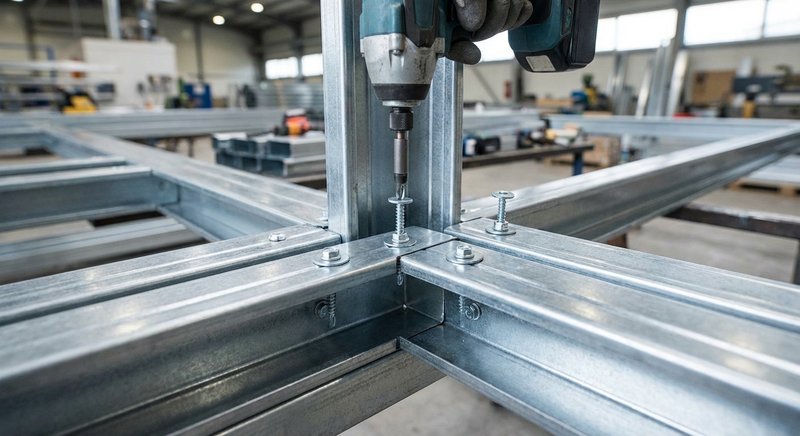
LGSF (Light Gauge Steel Framing) is a construction system made of galvanized steel profiles with a thickness of 0.8–3.0 mm. Unlike conventional steel framing (hot-rolled I-beams with a web thickness of 8–20 mm), LGSF profiles are formed using a cold process — without heating, on a roll-forming line. They are connected with bolts and self-drilling screws — welding is fundamentally not used, as it destroys the protective zinc coating.
The international name for the technology is Light Gauge Steel Framing (LGSF) or Cold-Formed Steel (CFS). In Ukraine, LGSF is designed according to Eurocode 3 and is used for warehouse construction, floor extensions, office, and residential buildings.
| Parameter | Value |
| Profile wall thickness | 0.8 — 3.0 mm |
| Steel grade | S350GD (yield strength 350 MPa) |
| Zinc coating | Z275 (275 g/m² — both sides) |
| Forming method | Cold roll-forming |
| Connection method | Bolts, self-drilling screws |
| Welding | NOT used |
| Manufacturing precision | ±0.5 mm (CNC line) |
| Zinc coating service life | 50–100 years |
LGSF is not "lightweight metal." It is a full-fledged structural system with calculated load-bearing capacity, designed according to Eurocode 3, manufactured on a CNC line, and assembled without welding. A 2 mm thick profile can withstand loads comparable to a timber beam with a cross-section of 150×200 mm.
LGSF profile types
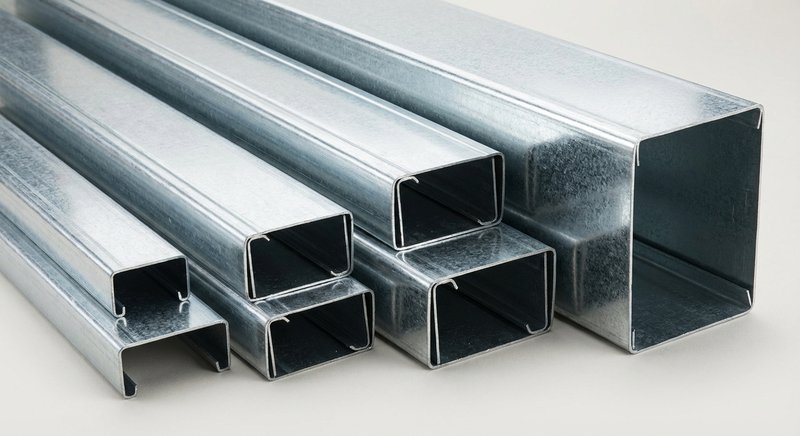
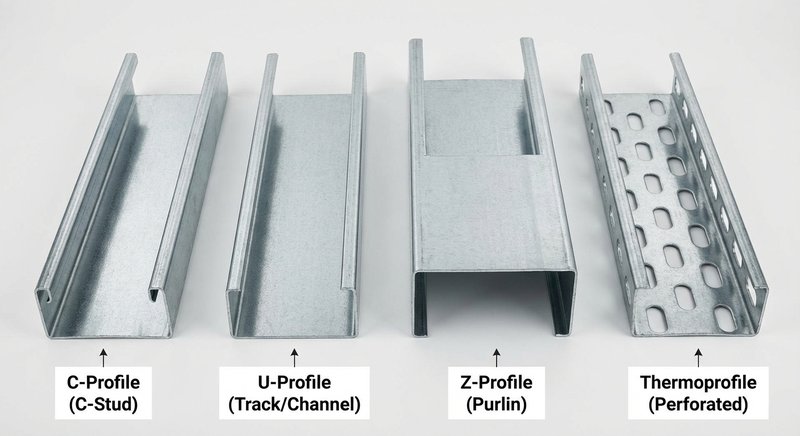
Every LGSF frame consists of several profile types, each serving a specific role in the structural system. Profiles differ in cross-section shape, dimensions, and function — from vertical wall studs to roof purlins up to 13.6 meters long.
| Profile | Characteristics |
| C-profile | Wall studs, columns. Flanges 48–83 mm, spacing 400–600 mm. The most common type. |
| U-profile | Horizontal tracks ("rails") into which C-studs are installed. Size matches the C-profile. |
| Z-profile | Roof purlins, wall girts. Height 100–300 mm, length up to 13.6 m. Long-span element. |
| Sigma profile (Σ) | Reinforced purlins with an increased moment of inertia. Used under higher loads. |
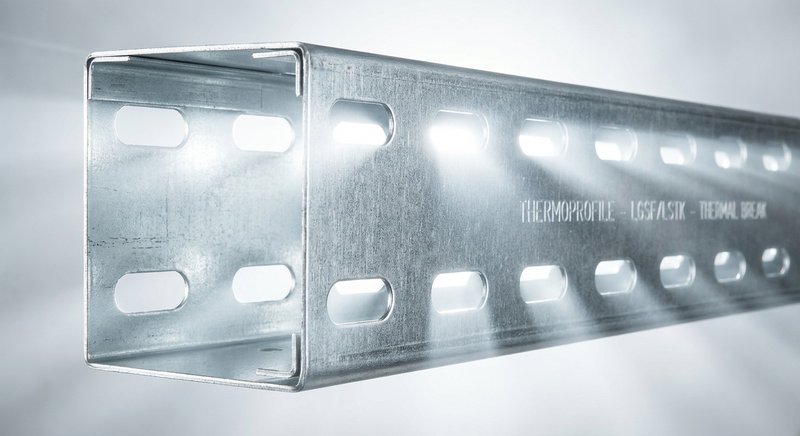
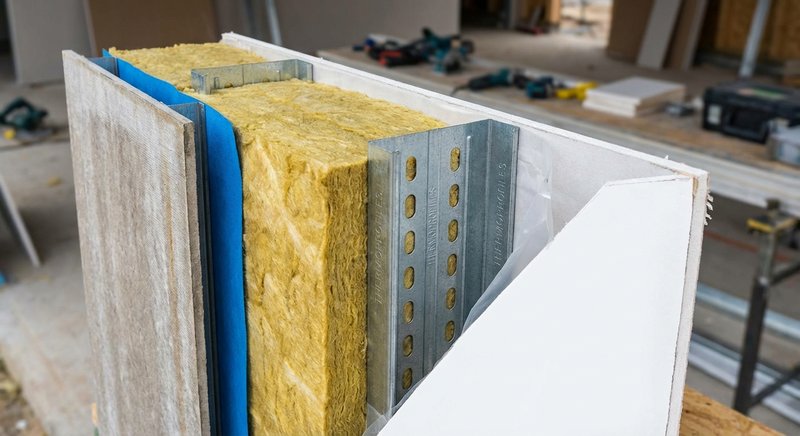
| Thermoprofile | C-profile with oval perforations in the web. Reduces thermal conductivity by 80–95%. For external walls and floor slabs. |
How LGSF is manufactured: from a steel coil to a finished frame
ReadyCon has its own manufacturing facility in Dnipro, where a steel coil is transformed into finished profiles in 15–20 minutes. The entire process is controlled by a CNC system — the operator sets the dimensions, and the computer performs profiling, perforation, cutting, and marking. Each element receives a unique number according to the fabrication drawings, so the frame is assembled on site like a construction kit — without fitting.
- Incoming steel inspection. Verification of thickness, zinc coating class (Z275), and steel grade (S350GD). A quality certificate for every batch. Non-conforming metal is not admitted into production.
- Coil unwinding. A steel coil weighing up to 10 tonnes is placed on the decoiler. The flat galvanized strip is fed into the line under controlled tension.
- Roll-forming on the profiling line. The strip passes through 16–24 pairs of forming rollers and gradually acquires the required shape: C, U, Z, or sigma profile. The process is cold — without heating the steel, which preserves the properties of the zinc coating.
- Perforation (for thermoprofile). A CNC punch creates oval holes in the profile web according to the design scheme. The perforations create a "labyrinth" for heat flow without reducing the load-bearing capacity.
- Cutting and marking. The CNC line cuts each profile to the design length with a precision of ±0.5 mm. Each element receives a unique number according to the fabrication drawings — on site, the installer knows exactly where to place this profile.
- Packaging and dispatch. Profiles are packaged in kits by assembly nodes and labeled with tags. A warehouse kit for 500 m² fits into a single long-haul transport trip. Delivery to any city in Ukraine takes 1–2 days.
At our factory, a single steel coil is transformed into finished profiles in 15–20 minutes. All dimensions are set by the computer — the operator only monitors the process. This is a fundamentally different level of precision compared to manual cutting and welding on site. Every profile leaves the factory with a precision of ±0.5 mm.
Thermoprofile and the "thermal bridge" problem
The main drawback of any steel frame is thermal conductivity. Steel conducts heat approximately 1,500 times better than mineral wool (50 W/(m·K) versus 0.035 W/(m·K)). Without special solutions, steel studs become "thermal bridges" — channels through which heat escapes from the building. Insulation effectiveness drops by 45–50%: the mineral wool between the studs works at only half its capacity.
Thermoprofile is the engineering solution to this problem. It is a standard C-profile with rows of oval perforations in the web. The holes are arranged in a staggered pattern, creating a "labyrinth" — the heat flow cannot pass through the steel directly and is forced to follow a zigzag path, losing energy.
–90% thermal conductivity
Oval perforations create a labyrinth that interrupts the direct heat flow through the steel web. Insulation performs at 90–95% of its nominal value.
No condensation
Eliminating "thermal bridges" prevents condensation on the inner surface of profiles — no moisture means no mold or corrosion.
Insulation compatibility
Thermoprofile works with mineral wool, PIR boards, and expanded polystyrene. The perforations do not reduce the load-bearing capacity of the profile.
DBN compliance
A 200 mm thick wall with thermoprofile meets DBN V.2.6-31 requirements for thermal resistance of building envelope structures.
Insulation comparison for LGSF
| Insulation | Characteristics |
| Mineral wool | λ = 0.034–0.037 W/(m·K). Non-combustible (class NG). Melting point >1000 °C. Optimal for walls, roof, and floor slabs. Thickness 100–300 mm. |
| PIR board | λ = 0.021–0.023 W/(m·K). Lowest thermal conductivity. Low flammability (G1). 130 mm PIR = 250 mm mineral wool. For roofing and areas with limited thickness. |
| Expanded polystyrene (EPS) | λ = 0.033–0.040 W/(m·K). Budget option. Flammability G1–G4 — requires fire barrier protection. For foundations, floors, external insulation. |
Fire resistance, standards, and comparison with alternatives
"Won't it burn?" — the most common question about LGSF. The answer: a steel frame does not burn (combustibility class NG — non-combustible). However, steel loses 50% of its load-bearing capacity at approximately 550 °C. Therefore, structural fire protection is a mandatory element of any LGSF building. The solution is straightforward: fire-resistant gypsum board + non-combustible mineral wool.
LGSF fire resistance classes
| Class | Solution and application |
| REI 30 | 1 layer of 12.5 mm gypsum board (type F) + mineral wool in the frame. For warehouses, hangars, auxiliary facilities. |
| REI 45 | Fire-resistant gypsum board (GKLO) + high-density mineral wool. For offices, commercial buildings. |
| REI 60 | 2 layers of 12.5 mm gypsum board (type F) + 100 mm mineral wool. For residential buildings, public facilities. |
LGSF vs timber vs reinforced concrete
| Parameter | LGSF | Timber | Reinforced concrete |
|---|---|---|---|
| Frame combustibility | NG (non-combustible) | G3–G4 (requires treatment) | NG |
| Biological resistance | Does not rot, no pests | Requires antiseptics | Resistant |
| Frame weight | Baseline (×1) | ×2–3 | ×9 |
| Seismic resistance | 7–9 points | 6–7 points | 7–9 points |
| Recyclability | 100% recyclable | Limited | Difficult and expensive |
| Service life | 50–100 years (Z275) | 30–50 years | 80–120 years |
| Regulatory framework (Ukraine) | Eurocode 3 (DSTU-N B EN 1993) | DBN timber structures | DBN reinforced concrete |
LGSF design standards in Ukraine
- DSTU-N B EN 1993-1-1 — Eurocode 3: general rules for steel structures
- DSTU-N B EN 1993-1-3 — Eurocode 3: supplementary rules for cold-formed profiles and sheets
- DBN V.2.6-198:2014 — Steel structures. Design standards
- DBN V.2.6-163 — Building and structure components. Steel structures from cold-formed profiles
The question "won't it burn?" is the most common one we hear. A steel frame does NOT burn — it is class NG. And structural fire protection (gypsum board + mineral wool) provides fire resistance of REI 30–60. This is sufficient for warehouses, offices, residential buildings — any type of facility we construct. All our projects pass expert review in accordance with DBN V.1.1-7.
Frequently asked questions about LGSF technology
LGSF (Light Gauge Steel Framing) is a framing construction technology using thin-walled galvanized steel profiles with a thickness of 0.8–3.0 mm. Profiles are manufactured at a factory according to project drawings, delivered to the site, and assembled with bolts — without welding, like a construction kit. LGSF is used to build warehouses, floor extensions, offices, and residential buildings.
Conventional steel framing (hot-rolled) consists of thick I-beams with a web thickness of 8–20 mm, joined by welding. LGSF uses thin-walled profiles (0.8–3 mm) connected with bolts and self-drilling screws. LGSF is 30–40% lighter, more precise in manufacturing (±0.5 mm instead of ±5 mm), and requires no welding on site.
Yes. The LGSF steel frame is non-combustible (class NG). With structural fire protection (gypsum board + mineral wool), fire resistance ratings of REI 30, REI 45, or REI 60 are achieved — sufficient for most building types under Ukrainian building codes (DBN V.1.1-7).
A thermoprofile is an LGSF profile with oval perforations in the web. The perforations create a "labyrinth" for heat flow, reducing thermal conductivity through the profile by 80–95%. Without a thermoprofile, steel creates "thermal bridges" — points where heat escapes from the building. The thermoprofile solves this problem while maintaining load-bearing capacity.
In Ukraine, LGSF is designed according to Eurocode 3 (DSTU-N B EN 1993), specifically Part 1-3 for cold-formed profiles. Additionally, DBN V.2.6-198:2014 (steel structures) and DBN V.2.6-163 (structures from cold-formed profiles) apply. ReadyCon designs all projects in compliance with these standards.
With Z275 galvanization (275 g/m² of zinc), the estimated service life of the frame is 50–100 years depending on operating conditions. For comparison: a timber frame lasts 30–50 years, reinforced concrete — 80–120 years. Galvanization protects steel from corrosion without additional painting or maintenance.
Want to build with LGSF?
Free on-site engineer visit from ReadyCon. We will calculate the optimal solution for your project: warehouse, floor extension, office, or residential building. We operate across all of Ukraine.

Own manufacturing: Dnipro, 15A Sicheslavska Naberezhna St.
readycon.com.ua · ReadyCon@ukr.net