Running out of space but no free land nearby. New construction means years and millions. Relocation means losing your location and clients. But there is a solution that delivers hundreds of extra square meters in 2–4 months, without demolition and without business downtime — a mansard floor extension on an existing building using LGSF technology.
What is a mansard extension and when is it needed
A mansard floor is a usable space under the sloped roof of a building, where walls are partially or fully formed by roof planes. Unlike an attic (which is an unheated technical space), a mansard is a full-fledged room with insulation, windows, utilities and finishing.
A mansard extension is the construction of a mansard floor on an existing building that originally did not have one. Essentially, it is a reconstruction: the old roof is dismantled and replaced with a lightweight frame and new roofing that creates additional residential or commercial space.
Who needs a mansard extension?
- Commercial building owners in Kyiv — office centers, administrative buildings where space is needed for expanding staff or new departments
- Retail and service facilities — shopping centers, car dealerships, service stations where extra square meters mean extra profit
- Industrial enterprises — factories, plants, warehouses that need additional amenity or administrative space without building a separate structure
- Residential building owners — private and multi-apartment buildings where a mansard allows increasing living area without changing the building's footprint
- Investors — a mansard floor increases property value and rental area with minimal investment compared to new construction
Mansard vs full floor: which to choose for an extension
This is the key question every client faces. The answer depends on the specific building, budget and purpose. Let's compare both options specifically in the context of extending an existing building — not new construction, where the logic differs.
| Parameter | Mansard floor | Full floor |
|---|---|---|
| Structure weight | 20–30% lighter | Higher foundation load |
| Cost per m² | From 480 $/m² | From 530 $/m² |
| Usable area | 75–85% of footprint | 95–100% of footprint |
| Wall height | From 0.8 m (slopes) to full height | Full height throughout |
| Aesthetics | Distinctive silhouette, modern look | Standard rectangular volume |
| Permits | Sometimes simpler procedure | Standard reconstruction procedure |
| Assembly time | From 60 days | From 75 days |
Choose a mansard when: the foundation has limited load-bearing capacity; you need to reduce the load; budget is tight; the building's appearance matters; the property is in a height-restricted zone.
Choose a full floor when: maximum usable area is needed; the foundation has sufficient capacity; large open spaces (open-plan offices, retail halls) are planned.
Why LGSF is the best technology for mansard extensions
LGSF (Light Gauge Steel Framing) is a frame technology where load-bearing elements are made from galvanized steel profiles 0.8–2.0 mm thick. For mansard extensions on existing buildings, LGSF is the optimal choice — here's why:
3–5 times lighter
LGSF frame weight — 25–40 kg/m² (vs 150–250 kg/m² for concrete). This allows avoiding foundation reinforcement in most cases.
Bolted assembly
No welding, no wet processes, no heavy machinery. The building continues operating normally — zero downtime for business.
Speed: 60–90 days
Components are manufactured at the factory in parallel with design. On site — assembly only. Frame assembly time — from 60 days.
Factory precision
All profiles are cut on a CNC line with 1 mm accuracy. No fitting needed on site — the frame assembles like a construction set.
Technology comparison for mansard extensions
| Parameter | LGSF | Wood | Brick / concrete |
|---|---|---|---|
| Frame weight, kg/m² | 25–40 | 30–50 | 150–250 |
| Foundation reinforcement | Usually not needed | Usually not needed | Almost always required |
| Assembly time | 60–90 days | 90–120 days | 4–8 months |
| Fire resistance | REI 45–90 (with fire protection) | Requires fire retardant treatment | REI 60–120 |
| Biological resistance | No rot, no mold | Requires treatment | Resistant |
| Manufacturing precision | ±1 mm (CNC) | ±5–10 mm | ±10–20 mm |
| No business downtime | Yes | Partially | No |
LGSF technology was originally created for reconstruction — that's where it reveals its maximum advantages. Low weight, dry assembly, factory precision — these are not just conveniences, but technical necessities when working with existing buildings.
Stages of mansard floor extension on an existing building
A mansard extension is an engineering-complex project that requires a clear sequence of steps. Here's how this process is organized at ReadyCon:
-
Building inspection and load-bearing capacity assessment
An engineer visits the site and inspects the foundation, load-bearing walls, floors and roof. A calculation is performed to determine the additional load the structure can support. This defines the maximum mansard weight and frame type. -
Design (architecture, structural steel, detailed drawings)
A complete set of design documentation is developed: architectural solutions, structural steel design (CM) and detailed structural steel drawings (CMD). The design accounts for loads, insulation, ventilation and utilities. -
Obtaining permits and documentation
Project approval, obtaining urban planning conditions and restrictions, passing expert review, securing construction permits. ReadyCon handles this entire stage. -
Manufacturing LGSF components at the factory
All profiles, panels and fasteners are manufactured at ReadyCon's own facility in Dnipro. The CNC line ensures 1 mm precision. Manufacturing runs in parallel with permit processing — saving time. -
Old roof dismantling
Careful dismantling of the existing roof with minimal impact on the building. A temporary protective canopy is installed if needed. -
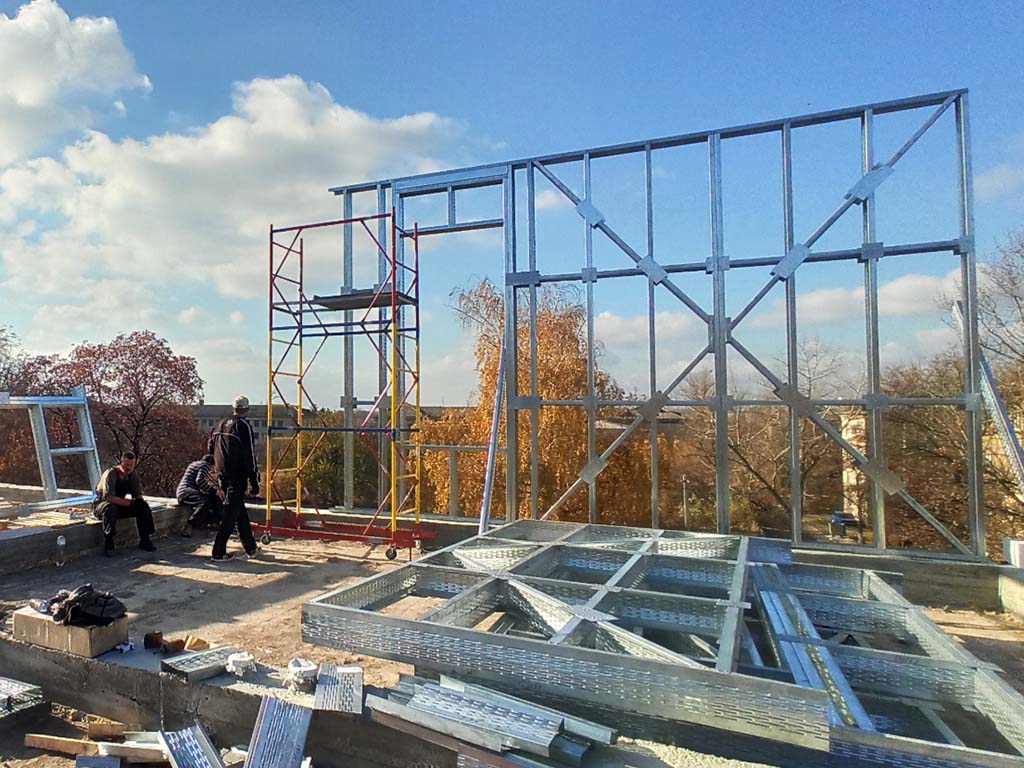
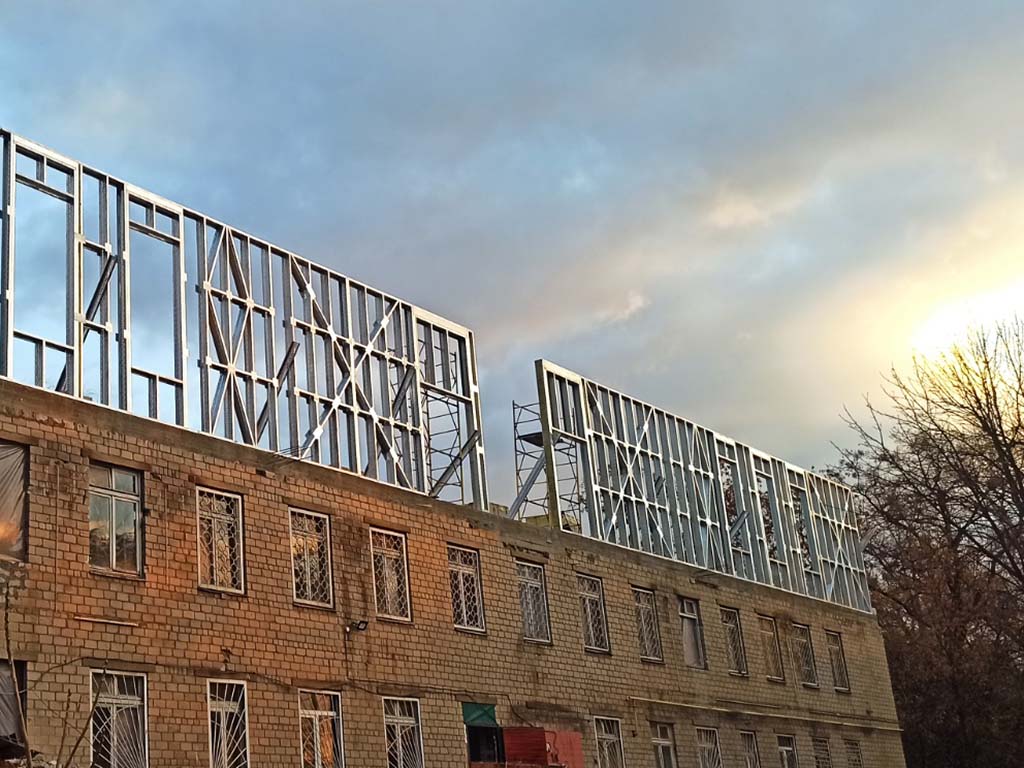
LGSF frame and enclosure assembly
Load-bearing frame assembly using bolted connections. Installation of wall and roof LGSF panels with 200–300 mm insulation. Window installation. -
Utilities and finishing
Electrical, heating, ventilation, plumbing. Interior and facade finishing per client's specifications. -
Commissioning
Filing the compliance declaration or certificate, registration in the state register. The client receives a fully legalized facility.
How much does a mansard extension cost in Ukraine
Pricing transparency is one of ReadyCon's core values. Below are approximate cost ranges for an LGSF mansard extension, current as of 2026.
| Package | What's included | Price from |
|---|---|---|
| Frame + roof | Load-bearing LGSF frame, metal roof, waterproofing | 320 $/m² |
| Warm shell | Frame + roof + wall panels with 200 mm insulation + windows | 480 $/m² |
| Turnkey | Warm shell + utilities + interior finishing + facade | 650 $/m² |
What affects the final cost
- Extension area — larger area means lower price per m² (economy of scale)
- Existing building condition — if floor reinforcement or additional calculations are needed, cost increases
- Insulation type — mineral wool 200 mm vs 300 mm; additional roof insulation
- Facade finishing — profiled metal sheet, siding, fiber cement panels or plaster
- Utilities — basic (electrical + heating) or extended (ventilation, air conditioning, fire alarm)
- Logistics — distance from the factory in Dnipro to the site in Kyiv
Comparison with alternatives
| Option | Price per m² | Timeline |
|---|---|---|
| Mansard extension (LGSF) | from 480 $/m² | 3–5 months |
| New construction (separate building) | from 700 $/m² | 8–14 months |
| Renting additional space (Kyiv, 5 years) | ~600–900 $/m²* | — |
* Calculation: office rent in Kyiv ~10–15 $/m²/month × 60 months = 600–900 $/m², while the space remains someone else's property.
ReadyCon fixes the price in the contract. No surcharges, no "surprises" during assembly. The client knows the final amount before work begins.
Documents and permits for mansard extension in Kyiv
A mansard floor extension is classified as reconstruction, which requires permit documentation. The procedure differs for residential and commercial buildings.
For commercial buildings (offices, shopping centers, warehouses)
-
Urban planning conditions and restrictions
Issued by the Department of Urban Planning and Architecture. Define permissible height, setbacks and restrictions. -
Design documentation
Complete reconstruction design including: architecture, structures, utilities, fire safety, energy efficiency. -
Design expert review
Mandatory for CC2 and CC3 facilities (medium and significant consequence class). For smaller facilities (CC1) — declarative principle. -
Construction permit
Issued by DABI (or authorized body). For CC1 facilities — registration of a declaration of intent to commence construction works. -
Commissioning
Upon completion — registration of compliance declaration or certificate. Updating the building's technical passport.
For residential buildings
- Private house — the procedure is similar, but usually consequence class CC1 (declarative principle), which simplifies the process
- Multi-apartment building — additionally requires consent of co-owners (HOA or 2/3 of apartment owners), plus a technical condition survey of the entire building
Completed ReadyCon projects
Every extension project is unique. Here is one of our largest completed case studies:
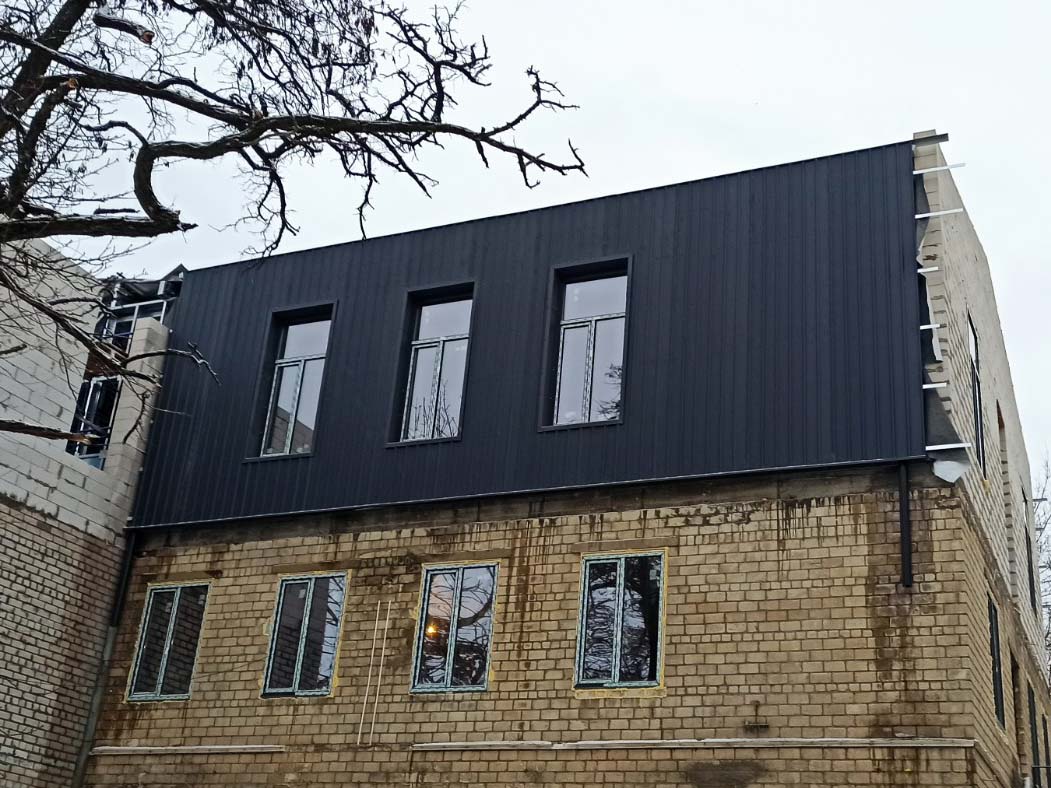
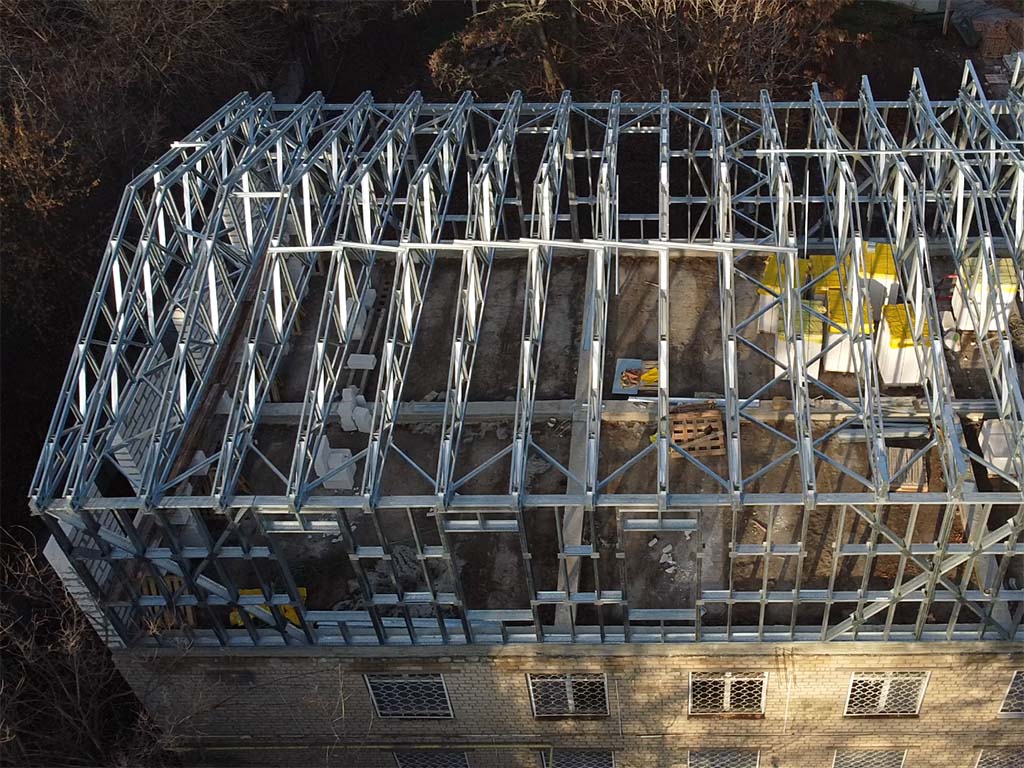
~990 m² extension on a commercial building, Dnipropetrovsk Oblast
The owner of a commercial building needed to double the floor area, but there was no free land nearby. ReadyCon specialists proposed a full mansard floor extension using LGSF.
| Plan dimensions | 43 × 23 m (~990 m²) |
| Extension height | 6.3 m |
| Roof height | 2.0 m |
| Perimeter walls | LGSF panels with 200 mm insulation |
| Ceiling | Mineral wool insulation 300 mm |
| Facade | Metal profiled sheets |
| Foundation reinforcement | Not required |
| Business downtime | 0 days |
The company has been operating for over 16 years with experience delivering 600+ projects across Ukraine — extensions, hangars, warehouses and commercial facilities in Kyiv, Dnipro, Lviv, Kramatorsk and other cities.
Frequently Asked Questions
In most cases — yes. An LGSF frame is 3–5 times lighter than a concrete or brick equivalent, so the existing foundation typically supports the load without reinforcement. Before starting work, ReadyCon engineers conduct a building inspection and load-bearing capacity assessment — this is a mandatory first step.
Yes. LGSF frame assembly uses bolted connections — no welding and no wet processes. The building continues to operate normally. In a project in Dnipropetrovsk Oblast (990 m²), the client didn't lose a single working day.
Frame and enclosure assembly — 60 to 90 days. The full cycle (inspection, design, manufacturing, assembly, finishing) — 3 to 5 months. Parallel manufacturing at the factory reduces the overall timeline.
From 480 $/m² for a "warm shell" (frame + enclosure + roof + insulation). Turnkey with finishing and utilities — from 650 $/m². The final cost depends on area, complexity and finishing type. ReadyCon fixes the price in the contract.
Yes. A mansard extension is classified as reconstruction, which requires design documentation, expert review and a construction permit. For commercial buildings, fire safety approvals are also needed. ReadyCon handles all documentation.
A mansard floor is 15–25% cheaper due to smaller wall area and the use of the roof as part of the enclosure. However, if maximum usable area is needed — a full floor may be more practical. ReadyCon engineers will help you choose the optimal option free of charge.
Yes. The old roof (often uninsulated or minimally insulated) is replaced with modern LGSF panels with 200–300 mm of mineral wool. This significantly reduces heat loss across the entire building and lowers heating costs.
Free on-site engineer visit
Preliminary assessment of extension feasibility and cost estimate — within 48 hours. We operate across Ukraine: Kyiv, Dnipro, Lviv and other cities.

Own manufacturing: Dnipro, 15A Sicheslavska Naberezhna St.
readycon.com.ua · ReadyCon@ukr.net