Reconstructing a commercial building is a more complex undertaking than new construction. It requires working with existing structures, hidden utilities, and constraints that cannot be anticipated without thorough analysis. Over 16+ years of experience, ReadyCon Engineering has delivered dozens of reconstruction projects — from floor extensions to complete modernization of business centers, shopping malls, and warehouses. This article covers the 7 most common mistakes that lead to 30-80% budget overruns, schedule delays, and even structural failures.
- A technical survey (1-3% of the budget) prevents 30-80% in overruns — a benefit ratio of 1:10.
- An LGSF frame (25-40 kg/m²) is 10 times lighter than concrete and eliminates the need for foundation reinforcement in 4 out of 5 projects.
- Building utilities account for at least 15-25% of the reconstruction budget; if the estimate shows less, it is incomplete.
- For consequence classes CC2/CC3, state design review, designer's supervision, and technical supervision are mandatory (DBN V.3.1-1:2002).
- Reconstruction without business interruption is achievable with LGSF + phased planning — the vast majority of ReadyCon projects have been delivered this way.
Who This Article Is For
Owners of business centers, shopping malls, and warehouses · developers · commercial real estate investors · manufacturing executives · chief engineers · design firms
Reading Time
12-15 minutes. The article includes comparison tables, numerical examples, a 10-question FAQ, and a step-by-step contractor selection guide.
1. Skipping the Technical Survey
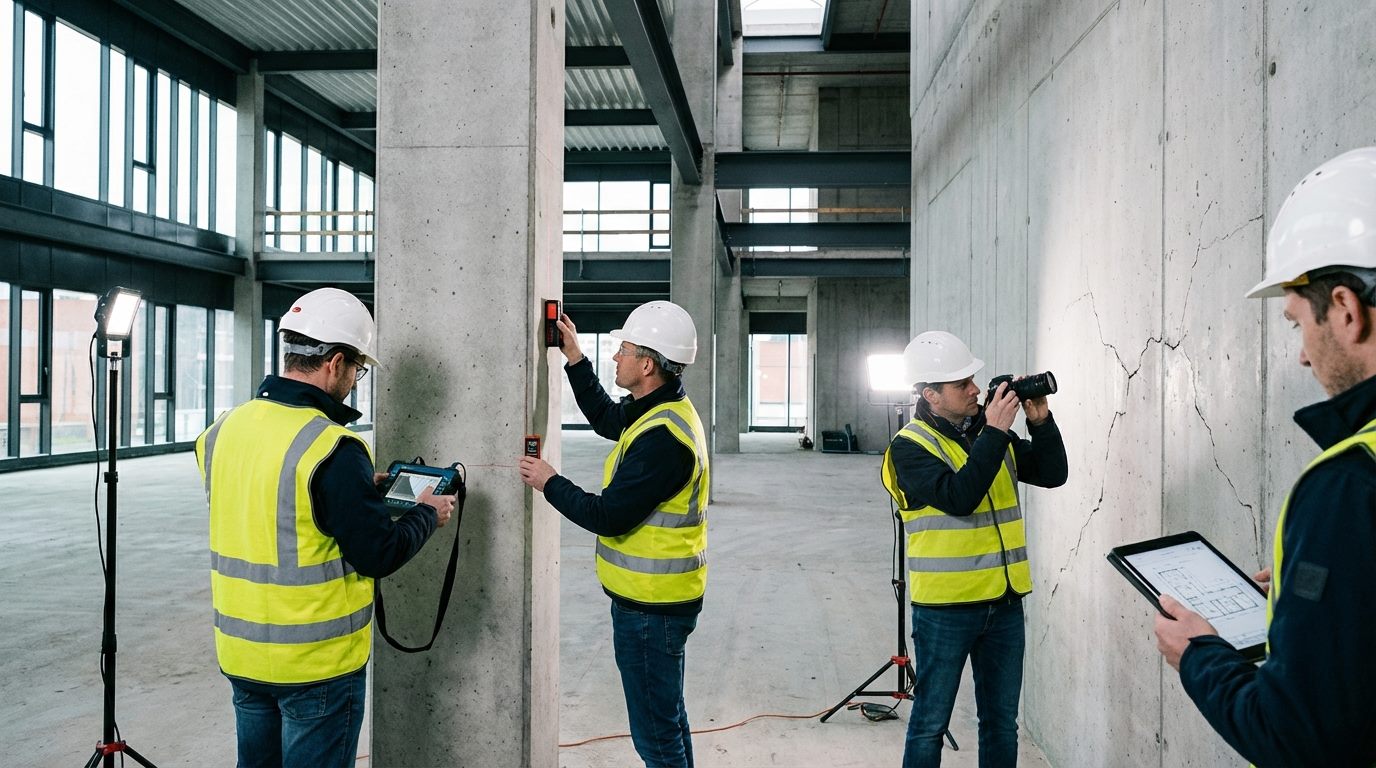
The most expensive mistake is starting reconstruction without a comprehensive technical survey of the building. This is the equivalent of performing surgery without diagnostics — the surgeon does not know what is inside and operates blindly.
What a Technical Survey Covers
- Foundation: type, depth, load-bearing capacity, presence of cracks, settlement, rebar corrosion. Methods: test pitting, geodetic surveying, laboratory testing of core samples.
- Load-bearing walls and columns: actual material strength (concrete, masonry), hidden cracks, vertical deviation. Methods: non-destructive testing (Schmidt hammer, ultrasound).
- Floor slabs: type (precast, cast-in-place), load-bearing capacity, rebar condition, deflection. Critical for floor extensions.
- Roof and connections: condition of trusses, purlins, joints. Corrosion, deformations, geometry deviations.
The Cost of This Mistake
A technical survey costs 1-3% of the reconstruction budget (UAH 30,000 to 150,000 for a typical commercial building). The cost of skipping it can reach up to 40% of the budget: unforeseen problems discovered during construction, redesign, and dismantling of already-installed structures.
2. Miscalculating Structural Loads
Reconstruction changes the loads on a building. Adding a floor, replacing the roof, installing new equipment — all of this adds tons that the existing structures must support. A calculation error results in either structural failure or unnecessary spending on reinforcement that was not actually needed.
Types of Loads Considered
| Load Type | Value Range |
|---|---|
| Dead load (structural weight, finishes) | 25-500 kg/m² (depends on material) |
| Live load (occupants, furniture, equipment) | 200-400 kg/m² (office: 200, warehouse: 400+) |
| Snow load (per DBN) | 100-180 kg/m² (depends on region) |
| Wind load | 40-80 kg/m² (depends on height and region) |
| Process load (equipment, overhead crane) | 50-2,000 kg/m² (project-specific) |
Simplified Calculation Example
Building in Dnipro, floor area 500 m². Planned: one-story extension for office use.
LGSF frame: 25 kg/m² x 500 m² = 12.5 t
Cladding (sandwich panels): 15 kg/m² x 500 m² = 7.5 t
Live load (office): 200 kg/m² x 500 m² = 100 t
Snow load: 160 kg/m² x 500 m² = 80 t
Total: ~200 t — distributed across the foundation perimeter.
For comparison, the same floor in cast-in-place concrete:
Monolithic slabs + walls: 400 kg/m² x 500 m² = 200 t
Live + snow load: 180 t
Total: ~380 t — nearly double, requiring foundation reinforcement.
3. Using Heavy Materials for Floor Extensions
The third critical mistake is using traditional heavy materials (cast-in-place concrete, masonry) for floor extensions on existing buildings. This necessitates foundation and structural reinforcement, increasing the budget by 25-40%.
Material Comparison for Floor Extensions
| Parameter | LGSF Frame | Cast-in-Place Concrete | Masonry |
|---|---|---|---|
| Structural weight | 25-40 kg/m² | 350-500 kg/m² | 200-350 kg/m² |
| Foundation reinforcement | Not required in 80% of cases | Required in almost all cases | Required in 60-70% of cases |
| Wet processes | None (bolted assembly) | Yes (concrete pouring) | Yes (bricklaying) |
| Winter installation (down to -15 °C) | Yes | Limited | No |
| Installation time (500 m²) | 45-60 days | 90-150 days | 120-180 days |
| Work without business interruption | Yes | No (vibration, noise) | Partially |
| Fire resistance | R30-R90 (with treatment) | R120-R240 | R60-R120 |
| Extension cost (turnkey) | from $480/m² | from $800/m² | from $650/m² |
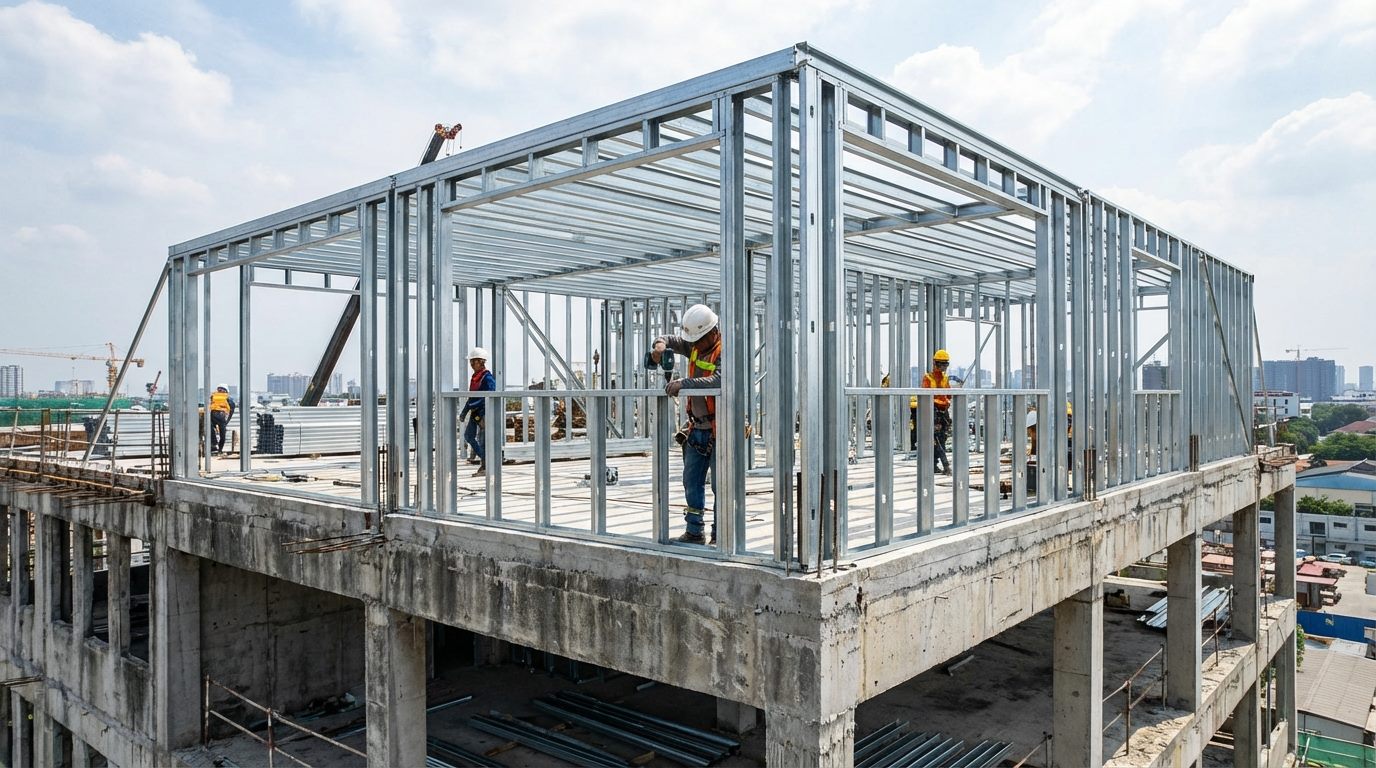
An LGSF frame for a floor extension is not a compromise — it is an engineering-driven solution. At 25-40 kg/m², it weighs less than the snow load in most regions of Ukraine. This means the existing foundation is already designed to handle this additional load.
Floor Extension Calculator
Estimate weight, budget and foundation reinforcement needs for your project
4. Ignoring Building Utilities
Commercial building reconstruction is not just about the structural frame. Building utilities often become the "hidden enemy" of the budget: they are overlooked during planning, then add 15-25% in unplanned costs.
Critical Building Systems
HVAC (Heating, Ventilation, Air Conditioning)
A floor extension changes air circulation throughout the building. Existing ductwork may not handle the additional load. Upgrade cost: $15-40/m².
Electrical Supply
Additional floor area = additional power capacity. If the existing supply is insufficient, utility company approval is required. Timeline: 2-6 months, cost: from UAH 50,000.
Fire Safety
Changing the number of stories requires recalculating evacuation routes, fire suppression systems, and alarm systems. Non-compliance results in work stoppage by the State Emergency Service.
Water Supply and Sewage
Additional restrooms, kitchens, and utility rooms require new risers. Routing them through existing floor slabs is a separate engineering challenge.
5. Underestimating Regulatory Requirements (DBN)
Commercial building reconstruction is governed by a series of DBN (Derzhavni Budivelni Normy — Ukrainian State Building Norms, the primary building code system in Ukraine). Ignoring regulatory requirements is not simply a risk of fines. It means work stoppage, redesign, and inability to commission the facility.
Key Regulatory Documents
- DBN V.3.1-1:2002 — the primary standard for building repair and reconstruction
- DBN V.1.2-14:2018 — general principles of structural reliability and safety
- DBN V.2.2-9:2018 — requirements for public buildings and structures
- DSTU-N B V.1.2-18:2016 — determination of consequence classes (levels of responsibility)
Consequence Classes: Why They Matter
| Class | Description |
|---|---|
| CC1 — minor consequences | Warehouses up to 300 m², temporary structures. Design review not mandatory. |
| CC2 — moderate consequences | Office buildings, retail premises up to 5,000 m², warehouse complexes. Mandatory state design review. |
| CC3 — significant consequences | Shopping malls, business centers over 5,000 m², buildings with high occupancy. Mandatory: design review + designer's supervision + technical supervision. |
6. Lack of Phased Planning
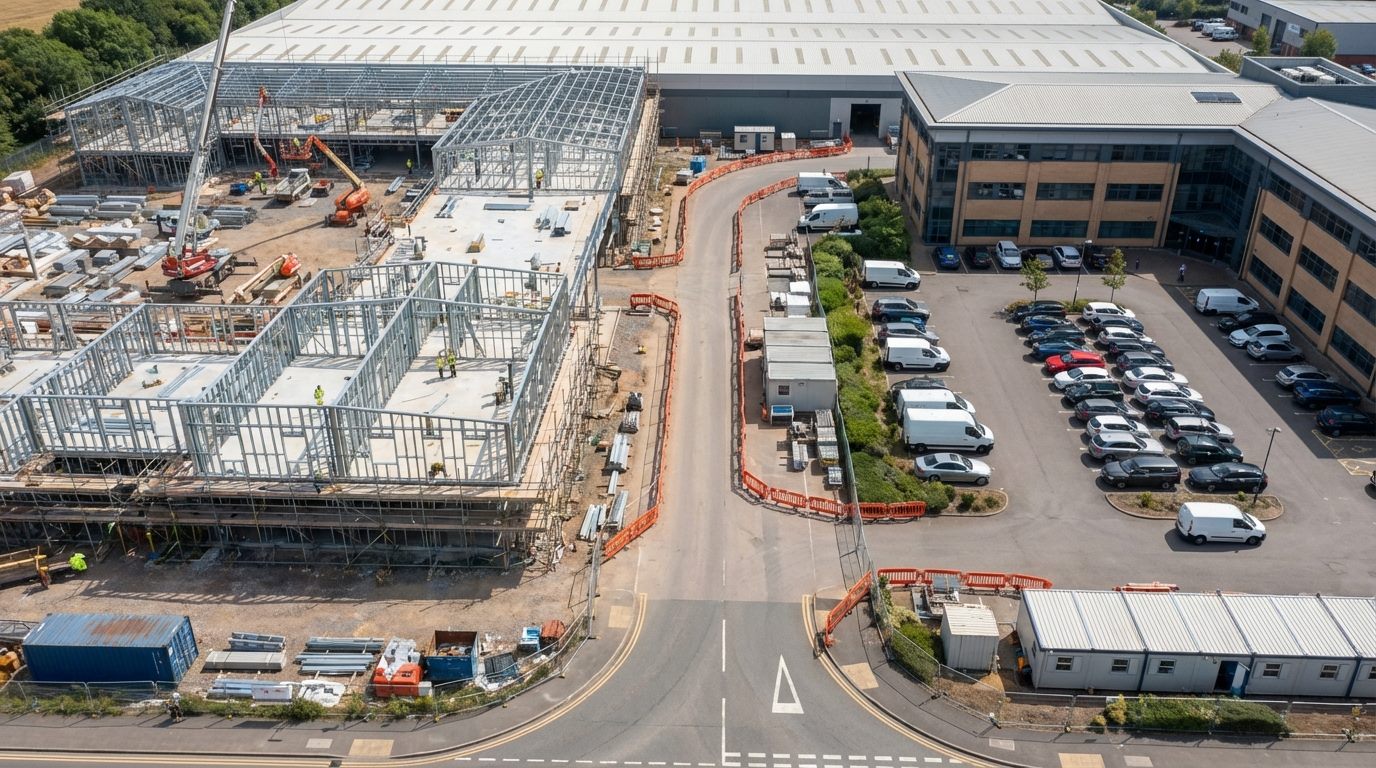
Reconstructing an operating commercial building always involves balancing construction quality with business continuity for tenants. Without a phased plan, the outcome is predictable: chaos on site, business interruption, tenant conflicts, and schedule overruns.
What a Phased Plan Must Include
Site Zoning
Dividing the building into zones: work zone (active reconstruction), buffer zone (restricted access), and operating zone (business continues). Clear boundaries and a schedule for transitioning between zones.
Material Logistics
Delivery routes and material storage areas that do not intersect with pedestrian and vehicle traffic of the operating business. Designated time windows for noisy work.
Safety
Barriers, protective screens, temporary lighting, warning tape. A designated safety officer for every shift.
Utility Switchover
Schedule for disconnecting and switching building utilities with minimal impact on occupied areas. Tenants notified 72 hours in advance.
Reconstruction without business interruption is not a marketing slogan — it is the result of meticulous planning. We have completed 80% of our reconstruction projects without shutting down operating businesses. The key: LGSF framing (dry assembly, no welding) and a phased plan coordinated with every tenant.
7. Choosing a Contractor Without Reconstruction Experience
New construction and reconstruction are not the same. They require different competencies, carry different risks, and demand a different approach to design. A contractor who excels at building hangars in an open field may fail when reconstructing an operating business center.
How Reconstruction Differs from New Construction
| Parameter | New Construction | Reconstruction |
|---|---|---|
| Baseline data | Fully known (design documents) | Partially unknown (survey required) |
| Constraints | Minimal | Existing structures, utilities, tenants |
| Risk of surprises | Low | High (hidden defects, buried utilities) |
| Planning requirements | Standard | Phased, accounting for business operations |
| Regulatory framework | DBN for new construction | DBN for reconstruction + building survey |
What to Look for When Choosing a Contractor
- Reconstruction portfolio — not new construction, but specifically reconstruction of operating facilities
- In-house design team — the ability to redesign quickly when unforeseen issues arise
- Licenses and permits — compliance with the consequence class of the building
- Payment terms — phased payments (not 80% upfront), fixed price in the contract
- Warranty — at least 5 years on structural elements, at least 2 years on finishes
Typical Reconstruction Scenarios
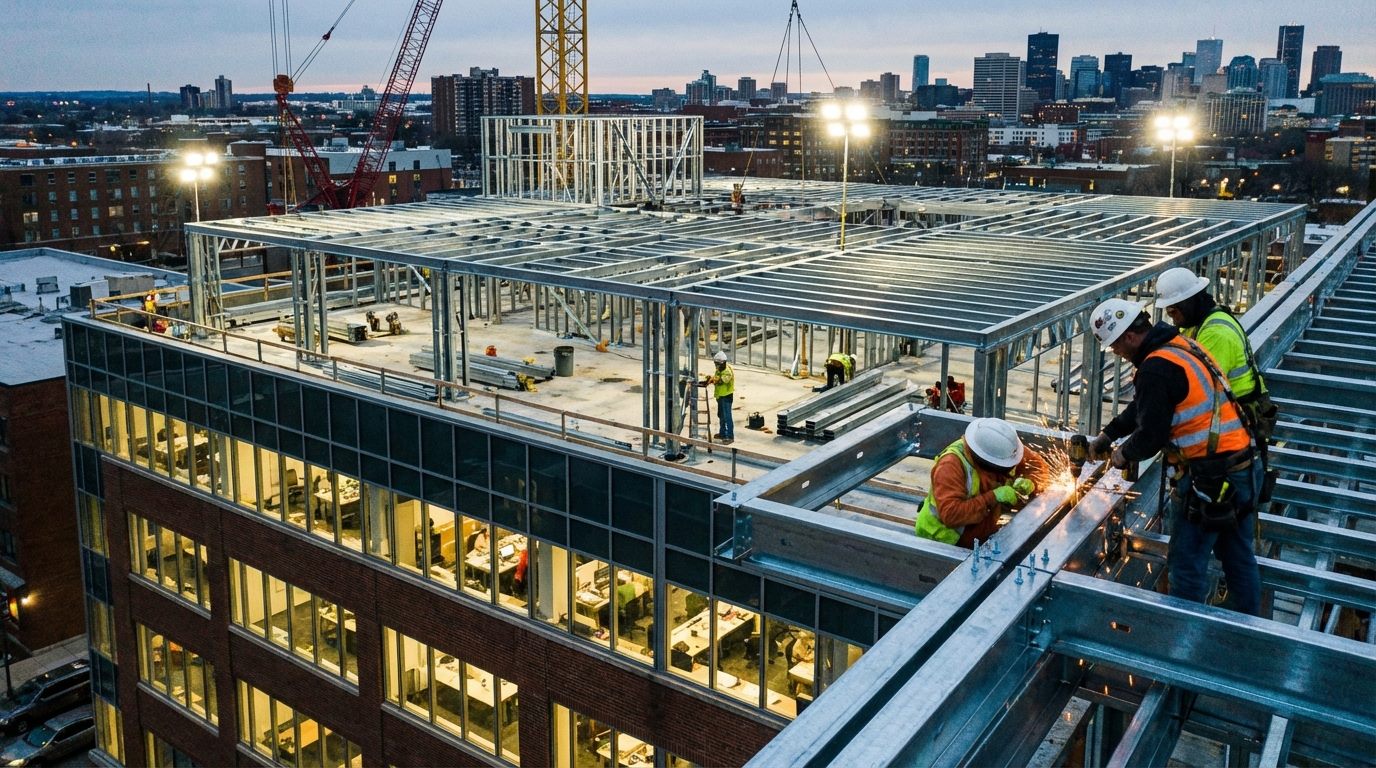
Three of the most common scenarios where the mistakes described above occur — and how to avoid them.
Office Floor Extension
Critical mistakes: #1 (survey), #3 (heavy materials), #6 (planning).
Solution: LGSF frame (25-40 kg/m²), phased installation, no foundation reinforcement.
Budget: from $480/m², timeline 60-90 days.
Warehouse-to-Office Conversion
Critical mistakes: #4 (utilities), #5 (DBN), #2 (loads).
Solution: full survey + recalculation of utilities (HVAC, electrical, fire safety).
Budget: from $350/m², timeline 4-6 months.
Shopping Mall Modernization
Critical mistakes: #5 (DBN — CC3), #6 (planning), #7 (contractor).
Solution: mandatory state review, designer's supervision, phased reconstruction by zones.
Budget: from $280/m², timeline 6-12 months.
Real Case: Office Floor Extension, Dnipro
| Parameter | Value |
|---|---|
| Facility | Operating business center, 3 stories, built in the 1970s |
| Scope | 4th floor extension for offices (990 m²) without tenant disruption |
| Material | LGSF frame, 120 mm sandwich panels (mineral wool), flat roof |
| Extension weight | 35 kg/m² (less than the snow load for Dnipro — 160 kg/m²) |
| Foundation reinforcement | Not required (confirmed by survey and structural calculation) |
| Timeline | Survey — 2 weeks, design — 4 weeks, installation — 67 days |
| Budget | ~$520/m² turnkey (structure + finishes + utilities) |
| Business interruption | 0 days — all 3 floors remained operational throughout installation |
The key factor in this project was that the survey confirmed sufficient reserve bearing capacity in both the 3rd-floor slab and the foundation. The LGSF frame weight (35 kg/m²) is less than the snow load the building was already designed for. Result: zero reinforcement, zero days of downtime, on-schedule delivery.
Engineering Summary
Based on the analysis of 7 common mistakes, here are the key takeaways:
A building survey is mandatory. Spending 1-3% of the budget prevents 30-80% in overruns. The benefit ratio is 1:10.
LGSF is the optimal material for floor extensions. Weight of 25-40 kg/m² (10 times lighter than concrete); foundation reinforcement is unnecessary in the vast majority of projects.
Building utilities account for 15-25% of the budget. If the estimate shows less, it is incomplete.
DBN compliance is not a formality. For CC2/CC3 buildings: state design review, designer's supervision, and technical supervision are mandatory.
Phased planning is the key to reconstruction without business interruption. Zoning, scheduling, logistics, utility switchover.
A contractor experienced in reconstruction is not the same as a new-construction contractor. Verify their reconstruction portfolio specifically.
Fixed price + phased payments — the only model that protects the client from budget overruns.
When Reconstruction Becomes High-Risk
Risk increases exponentially when multiple factors coincide. If your project matches 3 or more items from this list, engage a specialized contractor with reconstruction experience:
- The building is over 30 years old and lacks up-to-date technical documentation
- One or more floor extensions are planned
- The building has a consequence class of CC2 or CC3 (high occupancy)
- The existing foundation is strip or pile type (not mat/raft)
- The functional purpose is changing (warehouse to office, retail to restaurant)
- Reconstruction must proceed without shutting down the business
- The budget is tight and cannot absorb overruns exceeding 10%
- The schedule is rigid — there is a deadline (season, contract, permit)
How We Work
ReadyCon Engineering delivers turnkey reconstruction — from the initial consultation to facility commissioning.
Technical Survey
Comprehensive analysis of existing structures, utilities, and documentation. A report on the technical feasibility of reconstruction with recommendations. Timeline: 2-3 weeks.
Design
Detailed working drawings based on survey results. Load calculations, connection details, specifications. Price fixed in the contract. Timeline: 3-6 weeks.
State Review
For CC2/CC3 buildings — state or independent design review. Obtaining permits and approvals. Timeline: 2-4 weeks.
Construction
Structural fabrication at our own factory in Dnipro. Phased installation per schedule. Bolted connections — no on-site welding. Timeline: 45-120 days.
Supervision and Commissioning
Design compliance monitoring throughout construction. Preparation of commissioning documentation. 10-year warranty on structural elements.
Glossary of Terms
| Term | Definition |
|---|---|
| LGSF | Light Gauge Steel Framing — a structural system made from galvanized steel profiles 0.8-3.0 mm thick. Weight: 25-40 kg/m². Learn more about LGSF. |
| DBN | Derzhavni Budivelni Normy (Ukrainian State Building Norms) — mandatory regulatory documents governing design, construction, and reconstruction in Ukraine. |
| Consequence Class (CC) | A building classification by risk level: CC1 (minor), CC2 (moderate), CC3 (significant). Determines whether state design review and supervision are mandatory. |
| Load-Bearing Capacity | The maximum load a structure can support without failure or unacceptable deformation. |
| Technical Survey | A comprehensive investigation of an existing building: foundation, walls, floor slabs, roof. Purpose: to determine the actual condition and feasibility of reconstruction. |
| Sandwich Panels | Three-layer cladding panels: two metal skins + insulation core (mineral wool or PIR). Thickness: 80-150 mm, fire resistance: R30-R60. |
| Designer's Supervision | Monitoring of construction compliance with design documentation, performed by the design firm that authored the project. |
| Sclerometry | A non-destructive method for determining concrete strength using a Schmidt hammer (based on rebound force). |
Frequently Asked Questions
Yes, provided LGSF framing and phased planning are used. Dry assembly without welding, no vibration, and no wet processes allow work to proceed without affecting occupied areas. 80% of our reconstruction projects have been completed without business interruption.
When the additional load exceeds 15-20% of the foundation's bearing capacity, or when defects are found (cracks, settlement). With LGSF framing (25-40 kg/m²), reinforcement is not required in 80% of cases. Read more: Floor Extension Without Foundation Reinforcement.
An LGSF floor extension takes 60-90 days. Full reconstruction including utilities takes 4-8 months. Without a survey and design phase, timelines increase by 30-50%.
Exceeding the load-bearing capacity of structures, damaging hidden utilities, non-compliance with DBN codes, and budget overruns of 30-80%. A survey costs 1-3% of the budget; the cost of error is up to 40%.
Weight of 25-40 kg/m² vs. 350-500 kg/m² for concrete (a 10x difference). No foundation reinforcement needed, no wet processes, installation possible at -15 °C, and no business interruption. Cost starts at $480/m² (concrete: from $800/m²).
UAH 30,000 to 150,000 for a typical commercial building (1-3% of the reconstruction budget). Includes: foundation survey, load-bearing structure assessment, floor slab inspection, utilities audit, and laboratory testing.
The main ones are: DBN V.3.1-1:2002 (reconstruction), DBN V.1.2-14:2018 (reliability), DBN V.2.2-9:2018 (public buildings). State design review is mandatory for CC2/CC3 buildings.
Yes. With LGSF framing, 80% of cases require no foundation reinforcement. A technical survey, design, and state review (for CC2/CC3) are required. Cost starts at $480/m², timeline is 60-90 days. Read more: Mansard Floor Extension.
Verify their reconstruction portfolio (not new construction), in-house design team, licenses, payment terms (phased, not 80% upfront), fixed price in the contract, and a warranty of at least 5 years.
Full cycle: survey, design, state review, structural fabrication, installation, utilities, finishing, construction supervision, and commissioning. ReadyCon Engineering handles every stage independently.
Planning a Reconstruction?
Free engineering consultation: we will assess the technical feasibility, preliminary budget, and timeline within 48 hours. 16+ years of experience, own factory, fixed price, phased payments.

Own manufacturing facility: Dnipro, Sicheslavska Naberezhna St., 15A
readycon.com.ua · ReadyCon@ukr.net