The deficit of elevator capacity in Ukraine exceeds 15 million tons. Farmers lose part of their harvest every year due to a lack of quality storage facilities. A floor-storage hangar is the fastest and most affordable solution: from 150 $/m², assembly from 25 days, storage for any crop type. In this article — types of grain storage facilities, hangar vs silo comparison, ventilation and humidity requirements, and real prices for 2026.
Types of grain storage: hangar, silo, floor storage
There are three main types of grain storage facilities, each with its own advantages and limitations. The choice depends on storage volume, budget, crop type, and farm logistics.
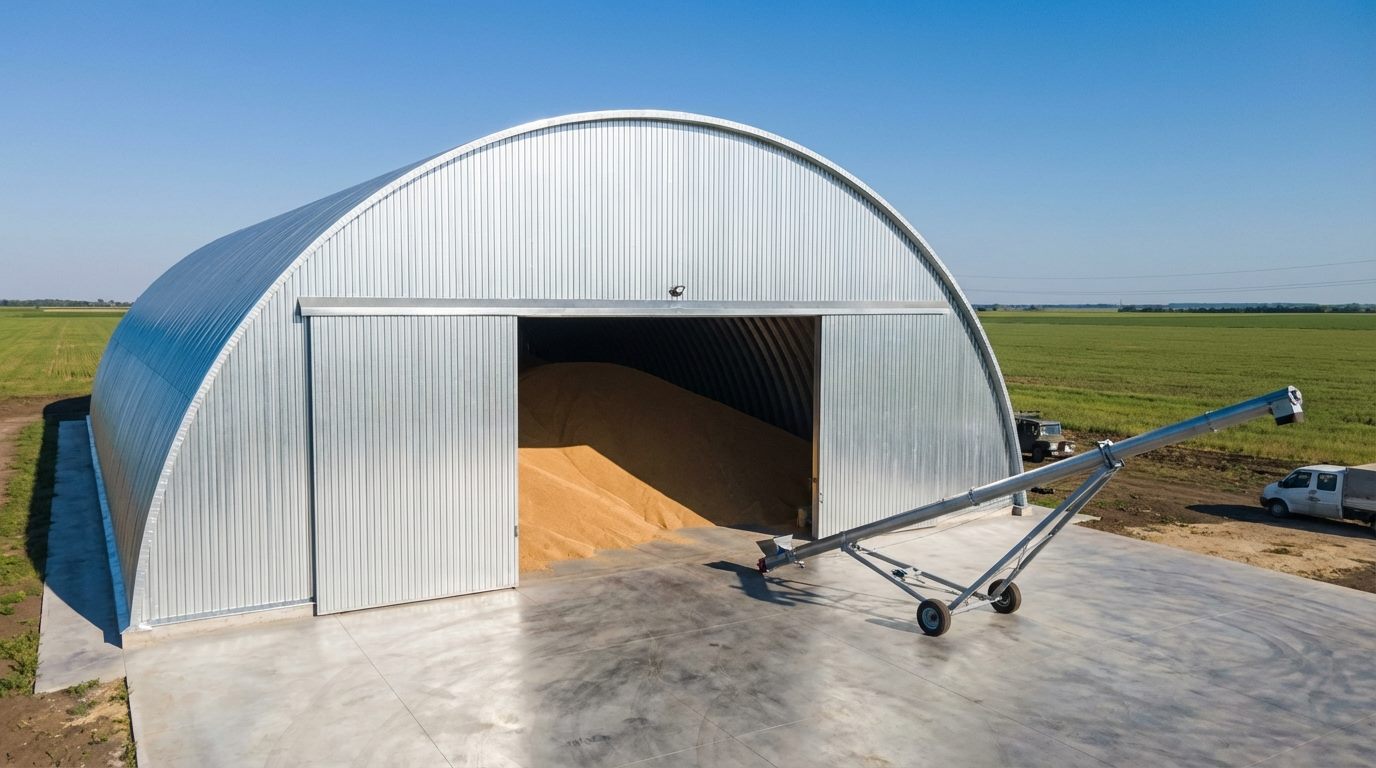
Arched hangar
Curved profile, floor storage. The most affordable option: from 150 $/m². Ideal for seasonal storage of up to 3,000 tons. Assembly from 25 days.
Silo bins
Metal cylindrical containers for vertical storage. Full automation, compactness. Price from 400 $/ton of capacity. For long-term storage of a single crop.
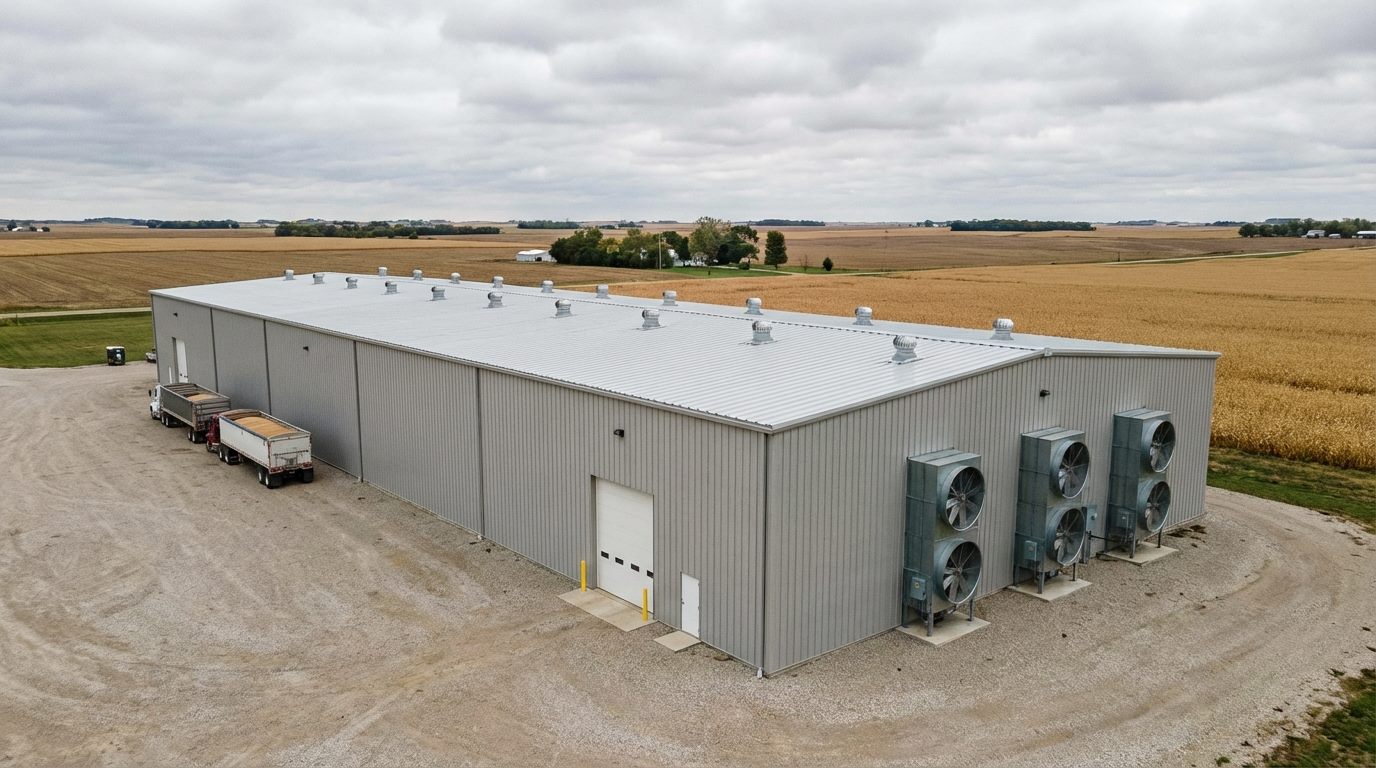
Straight-wall warehouse
Frame building with straight walls. From 220 $/m². Maximum functionality: hoppers, conveyors, crane beam. For large volumes and permanent storage.
| Parameter | Arched grain hangar |
| Structure | Curved profile, single shell |
| Optimal area | 200–1,000 m² |
| Center height | up to 8 m |
| Capacity | 500–3,000 tons |
| Storage type | Floor (bulk) |
| Ventilation | Under-floor + natural |
| Assembly time | from 25 days |
| Price | from 150 $/m² |
| Parameter | Straight-wall grain storage |
| Structure | LGSF frame: columns + trusses + purlins |
| Optimal area | from 500 m² |
| Wall height | 6–12 m |
| Capacity | from 2,000 tons |
| Storage type | Floor + hopper |
| Ventilation | Forced + under-floor |
| Assembly time | from 45 days |
| Price | from 220 $/m² |
Grain storage requirements: ventilation, humidity, temperature
The quality of grain storage is determined by three factors: humidity, temperature, and air exchange. Violation of even one parameter leads to grain self-heating, fungal growth, and loss of commercial quality.
Grain moisture
Wheat — up to 14%, corn — up to 14.5%, sunflower — up to 8%. Exceeding these levels = self-heating and mold. Mandatory drying before intake.
Temperature
Optimal 10-15°C. At 25°C+ self-heating begins. Monitoring via sensors in the grain mass. Ventilation with cool night air.
Ventilation
10-15 m³/h per ton of grain. Under-floor system + axial fans. Air humidity in the facility — no more than 65-70%.
Pest protection
Sealed joints, concrete floor, metal walls. Aspiration system for dust removal. Rodent protection — mesh on ventilation openings.
| Parameter | Grain storage facility standards |
| Air humidity | no more than 65-70% |
| Grain temperature | 10-15°C (optimal), no more than 25°C |
| Ventilation capacity | 10-15 m³/h per ton of grain |
| Wheat moisture at intake | up to 14% |
| Corn moisture at intake | up to 14.5% |
| Sunflower moisture at intake | up to 8% |
| Flooring | concrete M300+, waterproofing |
| Pile height (floor storage) | 3-5 m depending on crop |
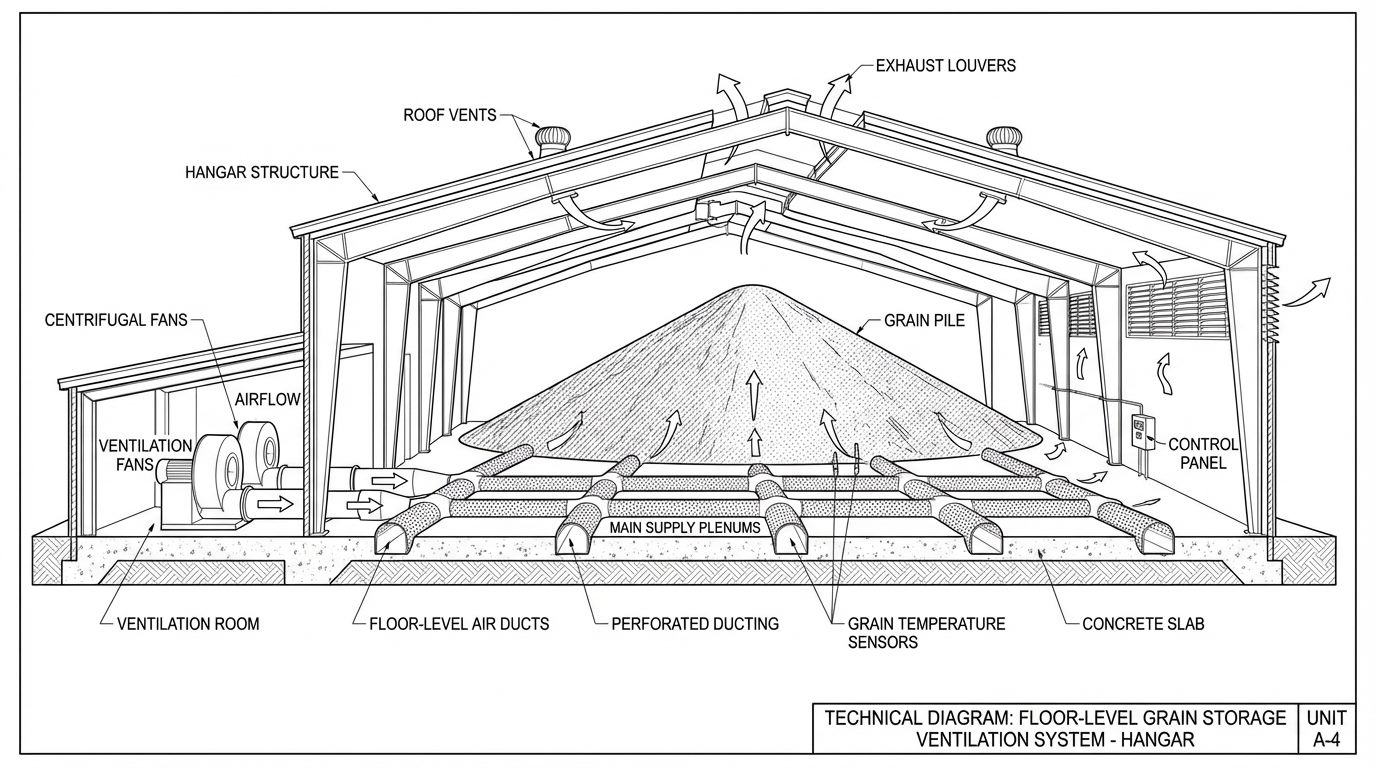
The biggest mistake farmers make is cutting costs on ventilation. A hangar without ventilation is not a grain storage facility — it is a tent. Grain self-heating begins within 3-5 days when temperature conditions are violated, and the resulting losses exceed the cost of a ventilation system by 10 times.
Hangar vs silo: which is more profitable for a farmer
The key question for any farmer: build a floor-storage hangar or install silo bins? The answer depends on volume, number of crops, logistics, and budget.
| Parameter | Hangar | Silo |
|---|---|---|
| Price per ton of capacity | from 50-80 $ | from 150-400 $ |
| Construction time | from 25 days | from 60 days |
| Multiple crops simultaneously | Several (partitions) | 1 crop per bin |
| Loading / unloading | Loader, tractor | Conveyors, bucket elevators (more complex) |
| Multi-functionality | Warehouse, equipment, fertilizers | Grain only |
| Automation | Limited | Full (loading, unloading, monitoring) |
| Compactness | Requires large area | Vertical storage |
| Long-term storage (12+ months) | Requires monitoring | Better airtightness |
| Storage volume | up to 5,000 t (single hangar) | up to 15,000 t (battery) |
| Service life | 50+ years (LGSF frame) | 25-30 years |
A typical scenario among our farming clients: first a 500 m² hangar for 1,500 tons for seasonal storage, then a year or two later — an expansion by another 500 m². The modularity of the LGSF frame allows increasing the area without rebuilding.
Grain hangar prices in 2026
The cost of a grain storage facility depends on the type of structure, area, insulation, and engineering equipment. Below are approximate turnkey prices from ReadyCon (excluding foundation and ventilation equipment, which are calculated individually).
| Type of grain storage | Area | Capacity | Price from |
|---|---|---|---|
| Arched uninsulated | 300 m² | ~800 t | 45,000 $ |
| Arched uninsulated | 500 m² | ~1,500 t | 75,000 $ |
| Arched insulated | 500 m² | ~1,500 t | 110,000 $ |
| Straight-wall uninsulated | 1,000 m² | ~3,500 t | 220,000 $ |
| Straight-wall insulated with ventilation | 1,000 m² | ~3,500 t | 300,000 $ |
| Grain complex (hangar + receiving + drying) | 2,000 m² | ~7,000 t | from 550,000 $ |
- Payback in 2-3 seasons. The price difference for grain at an elevator right after harvest versus 3-4 months later is 15-25%. For 1,500 tons of wheat, this means 30,000-50,000 $ in annual profit.
- Savings on elevator services. Receiving, drying, storage, loading — 30-50 $/ton per season. For 1,500 tons — 45,000-75,000 $/year.
- Independence from elevator schedules. Sell grain at peak price season, without queues or restrictions.
Grain storage construction stages
From the first call to loading the first batch of grain — a clear sequence of steps. The key is to finish before harvest season (July-August for winter crops, September-October for corn). Optimal start — February-March.
- Consultation and site visit. We assess the site free of charge, determine the storage volume, crop types, and logistics. Preliminary estimate — within 48 hours. We help choose the structure type: arched for budget savings, straight-wall for maximum capacity.
- Design and price fixation. A complete set of design documentation within 2-3 weeks: structural engineering, ventilation, flooring, gates. Ventilation system calculation for specific crops. The price is fixed in the contract.
- LGSF structure manufacturing. At ReadyCon's own factory in Dnipro: CNC cutting, galvanizing, labeling. Lead time — 3-4 weeks. Meanwhile, the client prepares the foundation and concrete floor.
- Frame and cladding assembly. Bolted assembly without welding. Arched hangar — from 25 days, straight-wall — from 45 days. Installation of ventilation ducts and equipment.
- Turnkey handover. Gate installation (sliding or sectional), fan and sensor mounting, commissioning. Handover of the facility with a complete document package.
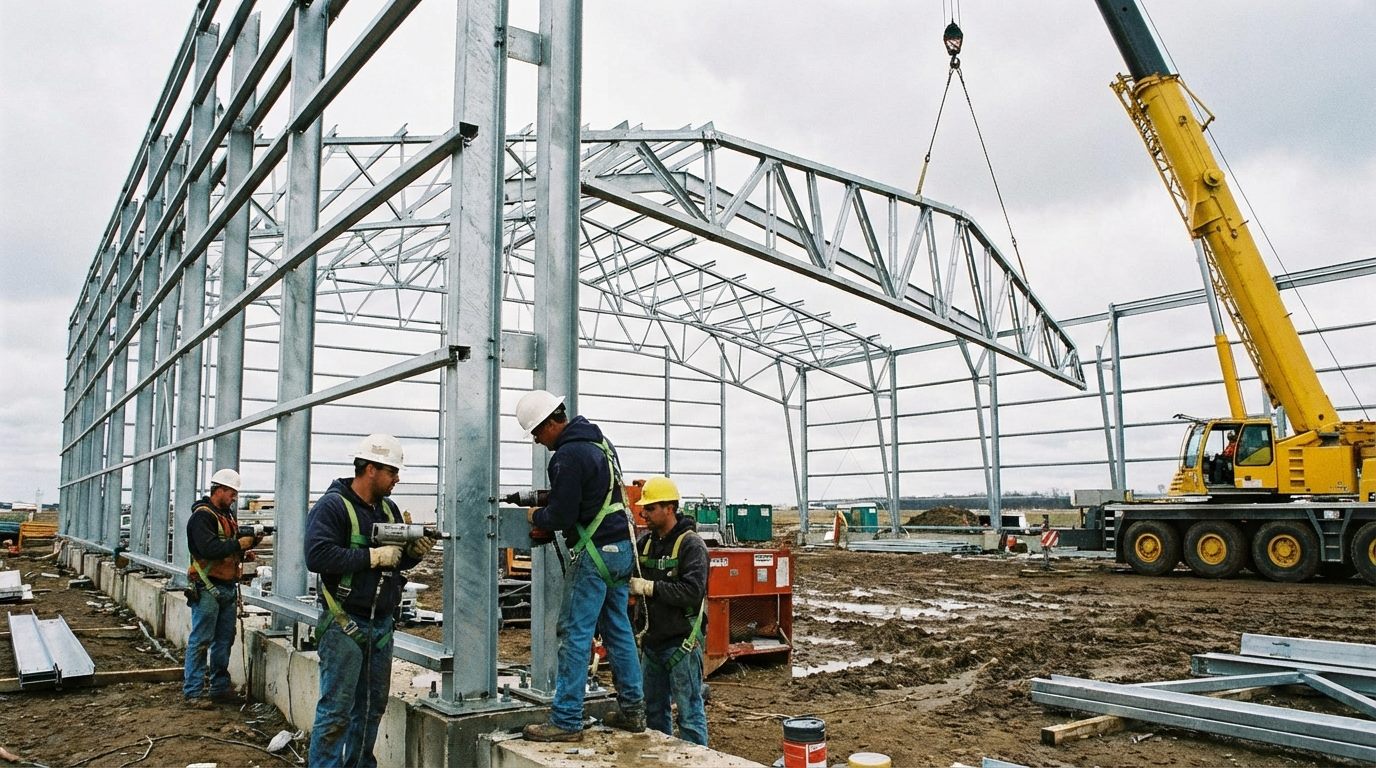
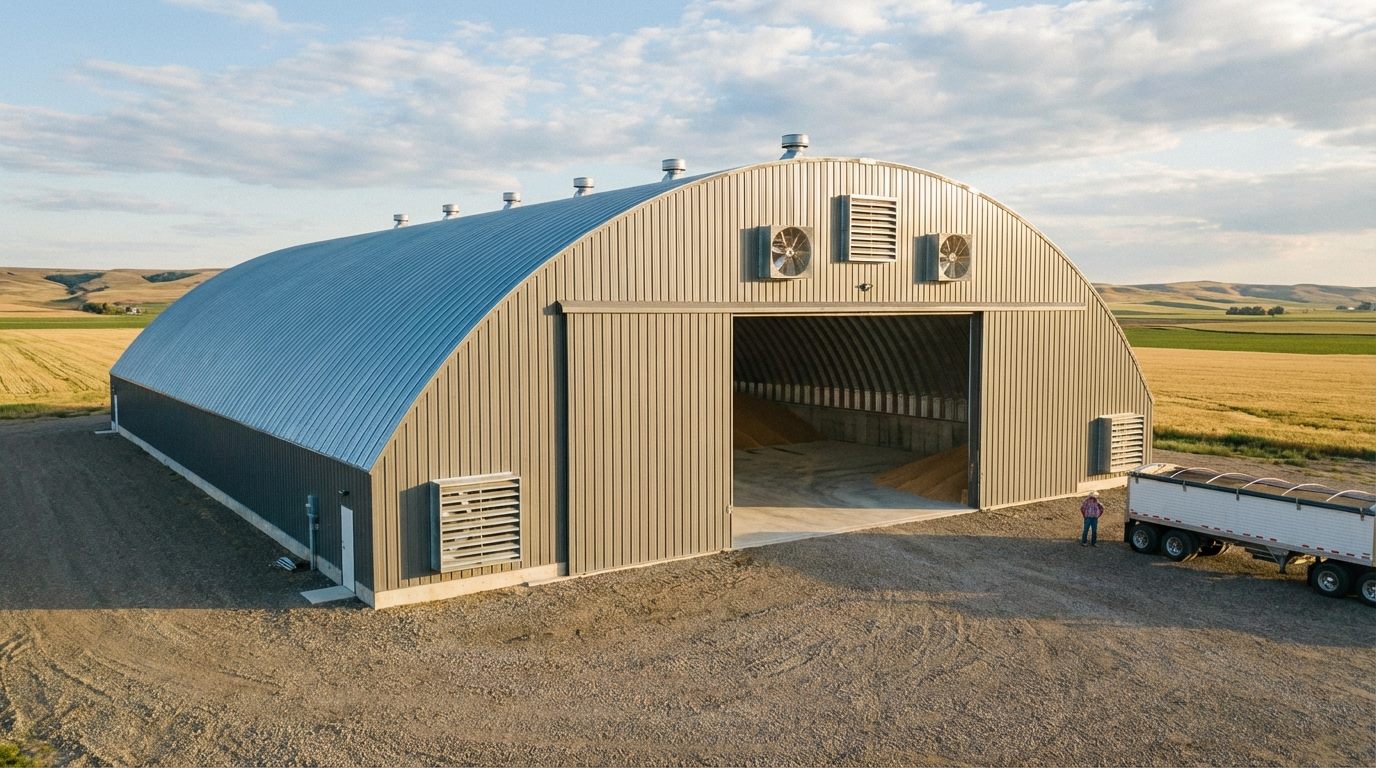
Task: seasonal storage of wheat and sunflower for a farming operation. Solution: arched hangar with under-floor ventilation, concrete floor with waterproofing. Result: assembly completed in 30 days, the hangar paid for itself in 2 seasons due to grain price differentials.
Task: grain storage with a receiving and drying line for corn. Solution: straight-wall LGSF frame, 8 m wall height, forced ventilation, conveyor line. Result: from design to handover — 4.5 months, complete independence from the elevator.
Fixed price in the contract — if steel prices increase during construction, that is our risk, not yours. Payment is phased: advance at signing, partial upon delivery of structures, remainder upon handover of the facility.
Frequently asked questions about grain storage
An uninsulated arched grain hangar with an area of 500 m² costs from 75,000 $, insulated — from 110,000 $. The price per m² starts from 150 $ for an arched and from 220 $ for a straight-wall grain storage facility. The cost includes design, LGSF structure manufacturing, delivery, and installation. Foundation, ventilation, and flooring add 15-25%.
A floor-storage hangar is 2-3 times cheaper per ton than a silo, simpler for loading/unloading, and allows storing multiple crops simultaneously. Silos are more compact and automated. For a farmer with volumes up to 5,000 tons, a hangar is the optimal choice.
Ventilation capacity — 10-15 m³/h per ton of grain. Air humidity in the facility — no more than 65-70%. An under-floor ventilation system with air ducts and axial fans is mandatory. Temperature and humidity sensors are required to monitor the condition of the grain mass.
An arched grain hangar with an area of up to 500 m² takes 25 to 40 days to assemble. A straight-wall grain storage facility of 500-1,000 m² takes 45 to 60 days. The full cycle from design to commissioning is 2.5-4 months. To be ready for winter crop harvest, start in February-March.
For 1,000 tons of wheat with floor storage at a pile height of 3-4 m, a hangar with an area of 350-450 m² is needed. For corn — 400-500 m² due to its lower bulk density. The exact calculation depends on the specific crop and building height.
Free grain storage estimate
Send us the area, crop types, and storage volume — we will calculate the exact cost within 48 hours. Fixed price in the contract, phased payment, ready before the season.

Own manufacturing: Dnipro, Sicheslavska Naberezhna St., 15A
readycon.com.ua · ReadyCon@ukr.net